
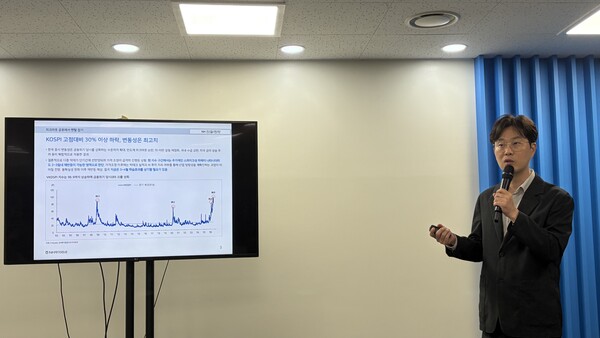
An analysis said South Korea's stock market is undergoing an excessive price adjustment as worries about the semiconductor industry passing its peak and geopolitical instability in the Middle East overlap.
Kim Byeong-yeon (김병연), a director at NH Investment & Securities, said at a seminar at the Korea Exchange in Yeouido, Seoul, on July 20 that the market is simultaneously reflecting worries about a semiconductor peak-out, the possibility of renewed U.S.-Iran conflict and competition from Chinese artificial intelligence (AI) models. But he said the current adjustment is somewhat excessive if semiconductor companies such as SK Hynix do not return to loss-making structures as they did in the past.
Kim presented a forward price-to-book ratio (PBR) of 1.3 to 1.4 times for domestic semiconductor companies as effectively the lower end of valuation. He said that translates into a KOSPI index level around 6,000.
He said that does not mean the KOSPI will immediately fall more than another 10 percent to 6,000. He said it means 6,000 could be supported even after pricing in all crisis situations, and if the index plunges to that level it is more likely to rebound quickly than to stay there for long.
He forecast that after a sharp price adjustment the KOSPI will rebound to the low-to-mid 7,000s and then go through a process of checking big tech companies' revenue and cloud growth rates. But he said if the index rises above 8,500, investors who bought near the top may again have a stronger desire to take profits.
On the recent semiconductor peak-out debate, he stressed that attention should be paid to absolute profit levels rather than the profit growth rate.
He said the pace of growth in semiconductor exports and corporate profits could slow, but profits are likely to stay at a higher level than in the past due to demand for AI servers and an expansion of long-term supply contracts.
Kim said momentum may appear to slow if one looks only at the semiconductor export growth rate, but the absolute level of export value has changed significantly from the past. He said even if a semiconductor cycle exists, the scale and duration of the cycle could differ from the past as demand for AI servers has increased.
He cited U.S. big tech companies' earnings releases scheduled for this week as a key variable that will determine market direction.
The market is worried about deteriorating cash flow due to AI investment and the possibility of reduced capital expenditure, but an analysis said global big tech companies are unlikely to easily change their investment stance in order not to fall behind in the competition for market share.
Kim said AI is a market share competition in which the final winner dominates the market. He said big tech companies are unlikely to change their AI capital expenditure stance even if the financial burden increases somewhat over the next 1 to 2 years.
He added that the most important question in the earnings releases is whether cloud revenue growth remains intact.
He also said there is no need to be overly pessimistic about flows in the domestic stock market.
Client deposits remain at a high level, and securities firms have pre-emptively raised margin rates, he said. That limits the likelihood that margin calls will trigger an additional sharp plunge across the overall market.
He also raised the possibility that foreigners' selling of semiconductor stocks may be past its peak.
He said that in the past, foreigners took profits when the semiconductor profit cycle was rising, and their ownership share in semiconductor stocks has now fallen to a level similar to past industry downturns.
Kim said it remains to be seen whether foreigners will again actively buy semiconductor stocks, but they have already sold a substantial amount. He said the intensity of foreign selling could gradually ease going forward.
He also said financial authorities' measures to supplement single-stock leveraged products had some effect in lowering market volatility.
But he said the biggest reason the market was more resilient than expected on the day was not the regulatory effect but the perception that stock prices have already moved close to valuation lows.
Kim said some regulatory measures could be seen as having an effect and the government's efforts also played a part. But he said the market did not fall more than expected because an awareness has formed that the bottom can be supported at current levels after an excessive price adjustment.
He forecast that policy momentum for the Kosdaq market will revive around September.
He said the Kosdaq market could enter a normalisation process if market structure improvement policies, such as applying tighter delisting standards and follow-up projects to the National Growth Fund, become more concrete.
Kim said the domestic market has a structural limitation in that when semiconductors fall, other sectors also fall together. He said the Kosdaq market has fallen excessively, but could receive new momentum if related policies begin to operate in earnest around September.
 Sang-yeop Oh
yub@d-today.co.kr
Sang-yeop Oh
yub@d-today.co.kr