
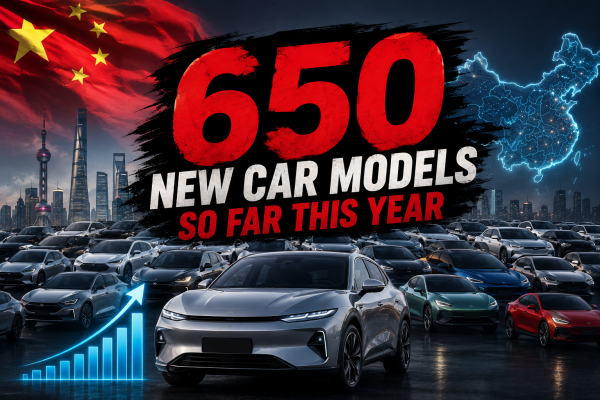
[DigitalToday reporter Jinju Hong (홍진주)] Chinese automakers are waging an unprecedented speed battle in the global car market, launching about 650 new vehicles and updated models in the first half of this year alone. That amounts to about four new vehicles entering the market each day, far exceeding the U.S. market.
InsideEV, an electric vehicle-focused outlet, reported on July 17 local time that Chinese automakers introduced about 650 new vehicles as well as facelifted and model-year changes from Jan. 1 to June 30 this year.
The tally includes both upgraded versions of existing models and entirely new vehicles. Separately, data from the China Automotive Technology and Research Center (CATARC) show that since the start of this year, about 30 entirely new models a month with no prior registration history in the national vehicle database have been launched. It means completely new models, beyond simple facelifts, are being continuously brought to market.
Even Chinese companies are expressing surprise at the pace of competition. BYD Vice President He Zhiqi (허즈치) wrote on social media that the scale of launches in the first half was “completely crazy,” adding that “China’s auto market is beyond fierce and is brutal.”
The gap becomes more pronounced compared with the U.S. market. In the United States, only 29 vehicles were launched or facelifted in all of 2024. Bank of America (BofA) Securities also forecast 159 new models will be launched in the U.S. market over the next four years. Compared with the 650 models China introduced in just six months, the scale difference is overwhelming.
Shortened development cycles underpin Chinese automakers’ push of new models. As sales growth slows and price competition intensifies, analysis says it is becoming common for companies to secure market share by launching new vehicles and upgraded models faster than competitors.
Technology competition is also accelerating the trend. Wider use of artificial intelligence in vehicle design and software development is shortening development periods, while advanced driver assistance systems, high-density batteries and ultra-fast charging are emerging as key factors in consumers’ buying decisions. As a result, quickly rolling out new models is becoming a way to demonstrate technological competitiveness beyond a simple volume race.
BYD views the competition as a driver of growth. He said, “Competition also creates prosperity.” BYD has set a goal of becoming the world’s largest automaker within the next five years, and it recently regained the top spot in global electric vehicle sales from Tesla.
The industry says the release of 650 models in the first half is an example showing the competitiveness of China’s auto industry, which is putting forward not only price competitiveness but also development speed and product diversity, as Chinese automakers expand their influence in Europe and explore entry into North America. Attention is on whether the new-model offensive will continue in the second half, and what synergy it will create with strategies to expand in global markets.
 Jinju Hong
hongjj@d-today.co.kr
Jinju Hong
hongjj@d-today.co.kr