
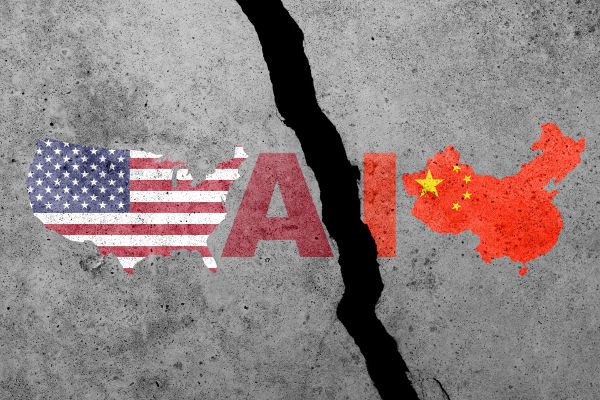
[DigitalToday reporter Chi-gyu Hwang] Chinese AI startups appear to be gaining momentum in an offensive aimed at increasing their foothold against OpenAI and Anthropic, seen as the global AI sector’s top 2. Some now view Chinese AI companies as more than formidable value-for-money challengers and rate them in the same weight class as OpenAI and Anthropic.
DeepSeek’s V4 large language model, introduced in April, drew attention for its overwhelming value for money. Z.ai’s GLM 5.2, released in June, stirred a strong reaction in the global AI market with agentic capabilities comparable to Claude Opus 4.8 and OpenAI GPT-5.5 at a low price.
The scale of the shock Chinese AI startups are bringing to global markets appears to be growing. Moonshot AI, one of China’s representative AI companies alongside DeepSeek and Z.ai, will disclose the weights for its new open-source-based LLM Kimi K3 on the 27th, and it is drawing attention by stressing that it outperformed OpenAI and Anthropic’s top-end models on some tasks.
Kimi K3 went beyond drawing attention in the AI world and also rattled U.S. stocks. Shares of semiconductor companies such as Nvidia and Micron fell sharply. The VanEck Semiconductor ETF is down about 7 percent this week alone. That is the steepest weekly drop in the past year. TSMC and ASML posted impressive quarterly results, but they were not enough to reverse the decline.
The scene is similar to when Nvidia shares briefly wobbled after DeepSeek released its R1 reasoning model in January last year. But some say the scale and nature of the shock are different from the DeepSeek shock because more companies’ shares fell this time, and the affected stocks may not follow a path of dipping briefly and then recovering.
Kimi K3 is a 2.8 trillion-parameter model, the largest open-source model released so far. It is also at a level that does not lag behind closed models. Anthropic does not disclose the parameter size of its models, but outside researchers estimate that Anthropic’s Claude Opus 4.8, released in May, has more than 1.5 trillion parameters.
This is not the first time Chinese AI companies have drawn attention in global markets, but how should the reason Kimi K3 shook U.S. stocks be viewed?
It appears to be the result of rising doubts about the economics of high-cost IT infrastructure that underpins advanced AI.
According to a Wall Street Journal report, U.S. stocks rose this year on expectations that companies such as Google, OpenAI and SpaceX would require massive hardware, including semiconductors, to develop and use AI.
Chinese AI models are offered as open source and can be operated using fewer computing resources than U.S. AI models. As a result, if Chinese AI models gain share, demand for AI infrastructure may not surge as much as expected, and some investors are worried about that.
OpenRouter, which provides a router platform that allows multiple AI models to be mixed and used as needed, said the top 5 models in corporate AI token usage rankings are all Chinese. About 45 percent of all tracked AI tokens are being processed through Chinese models.
Debate over an AI bubble has continued over the past few years, but stock declines driven by AI bubble concerns did not last long. Big Tech companies continued their aggressive push for AI infrastructure investment, which led to gains in shares of infrastructure-related companies.
But shares of AI infrastructure-related companies, including Nvidia, have been falling, and the decline became pronounced after the Kimi K3 announcement. Stocks could follow the DeepSeek pattern of dipping briefly and then rising again, but there are also many who see that as unlikely this time. Skepticism is also growing over whether the funds Big Tech companies are pouring into AI infrastructure will deliver returns. Kimi K3 is seen as reinforcing such concerns.
A Business Insider report said Mark Malek (마크 말렉), chief investment officer at Siebert Financial, said of the Kimi K3-driven stock drop, "The U.S.-China frontier AI gap has narrowed much more. The news came at the very moment Wall Street began questioning the profitability of AI investment."
Kent Fung (켄트 펑), vice president of market intelligence at Fundstrat, said, "The rotation out of AI capex beneficiaries has been under way for weeks, but this move was likely catalyzed by Moonshot launching Kimi K3."
 Chi-gyu Hwang
delight@d-today.co.kr
Chi-gyu Hwang
delight@d-today.co.kr