
[DigitalToday reporter Oh Sang-yeop (오상엽)] Domestic stocks are expected to test the possibility of a rebound this week. Market attention is focused on Alphabet’s artificial intelligence (AI) capital spending plans and SK Hynix earnings.
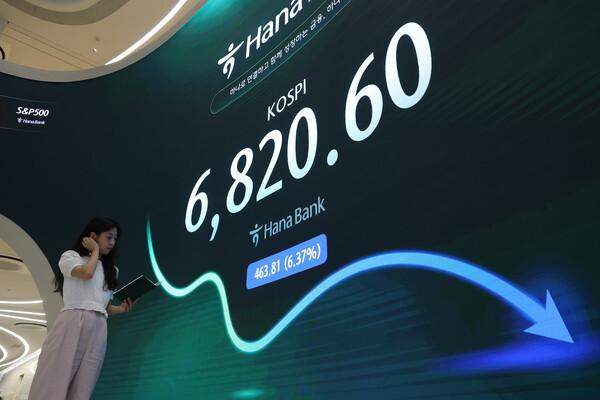
Domestic stocks swung sharply last week, alternating between steep falls and rapid rebounds. The Korea Exchange said the KOSPI fell just 0.1 percent from July 10 to 15, while the Kosdaq rose 4.5 percent. Worries over heavyweight semiconductor shares persisted, but the market recouped most losses on stabilising U.S. inflation and bargain hunting.
Investor flows also began to shift. Individual investors absorbed selling by foreigners and institutions in the early stage of the selloff, but during the rebound individuals sold while foreigners and institutions bought, mainly in large semiconductor stocks.
With the won’s weakness easing and foreign ownership of Samsung Electronics and SK Hynix down to near historic lows, the rebound could gain momentum if foreigners’ net buying continues.
Lower U.S. inflation concerns are also positive. Both the U.S. June consumer price index (CPI) and producer price index (PPI) came in below market expectations. That eased worries about additional tightening and reduced cost pressures on AI data centre investment, which relies heavily on corporate bond issuance and external funding.
Some concerns surrounding the semiconductor cycle have also eased. TSMC posted record second-quarter revenue, and ASML also delivered earnings above market expectations and raised its full-year outlook.
Demand for advanced AI chips and memory continues, and it has been confirmed that semiconductor companies’ capacity expansions are aimed more at meeting demand than creating oversupply.
The biggest focus this week is Alphabet earnings, due in the early hours of July 23 Korea time. The market is expected to focus less on revenue and profit and more on AI-related capital expenditure (CAPEX) plans.
If Alphabet raises its AI infrastructure investment outlook, it could ease worries about a slowdown in big tech spending and support domestic semiconductor, power equipment and data centre-related shares.
If AI spending plans are maintained or lowered, a recently raised debate over the profitability of AI investment could intensify again. Alphabet’s results are expected to serve as an indicator to gauge mid- to long-term demand for domestic semiconductor companies such as Samsung Electronics and SK Hynix, beyond being just big tech earnings.
SK Hynix’s second-quarter results, scheduled for July 24, are also important. SK Hynix operating profit forecasts for this year and 2027 have edged down after hitting a peak. Investment sentiment toward semiconductor stocks could shift depending on high-bandwidth memory (HBM) selling prices, the demand outlook and future supply plans.
If results fall short of expectations or the outlook is presented conservatively, profit-taking selling could emerge after the earnings release.
Valuations in domestic stocks are also near historic lows. The KOSPI’s 12-month forward price-to-earnings ratio (PER) fell to the high 5-times range during the selloff, a level below the low reached during the 2008 global financial crisis.
In contrast, forward earnings per share (EPS) rose from the end of June. That means earnings forecasts improved, while share prices alone fell sharply.
Whether rotation in the Kosdaq continues is also in focus. Since the launch of single-stock leveraged exchange-traded funds (ETFs), individual money has crowded into products tied to Samsung Electronics and SK Hynix, leaving Kosdaq growth stocks relatively sidelined.
Expectations are rising that excessive concentration in flows could ease as the government pushes supplementary measures for leveraged ETFs and policies to revitalise the Kosdaq.
Ultimately, this week’s market is expected to be a phase to check whether stabilising inflation and improving semiconductor earnings translate into an actual expansion in big tech investment.
If Alphabet expands AI investment and SK Hynix presents solid results and guidance, the KOSPI rebound could strengthen. If investment plans and earnings guidance disappoint, high volatility could re-emerge.
Jae-won Lee (이재원), an analyst at Yuanta Securities, said, "The direction of semiconductor demand, supply and profits has not changed enough to justify this sharp fall." He added, "Maintain a large-cap semiconductor-focused strategy, but it is also necessary to look at Kosdaq names that meet both oversold declines and EPS upgrades."
Kyung-min Lee (이경민), an analyst at Daishin Securities, said, "As fundamentals have not been damaged in the recent sharp decline, a steep drop driven by weaker sentiment and flow volatility is a bargain-buying opportunity that uses increased valuation appeal." He added, "If semiconductor profit expectations recover on the back of SK Hynix’s earnings release, the KOSPI’s upside momentum will also strengthen."
 Oh Sang-yeop
yub@d-today.co.kr
Oh Sang-yeop
yub@d-today.co.kr