
Cryptocurrency prices fell sharply in the first half of this year, while listed crypto-related companies posted double-digit returns, showing a different trend from the broader market, a report showed. Growth within the industry, including DeFi, real-world assets (RWA) and prediction markets, drove strength in related stocks, it said.
CoinPost, a blockchain media outlet, reported on July 16 that U.S. digital asset manager Bitwise said in its second-quarter 2026 market report that a clear gap emerged between cryptocurrency prices and related stocks in the first half.
Ryan Rasmussen (라이언 라스무센), head of research at Bitwise, looked back on the second quarter and said profitability, real-world use and institutional adoption continued to expand, but cryptocurrency prices fell overall. He said market conditions should not be interpreted only through price moves.
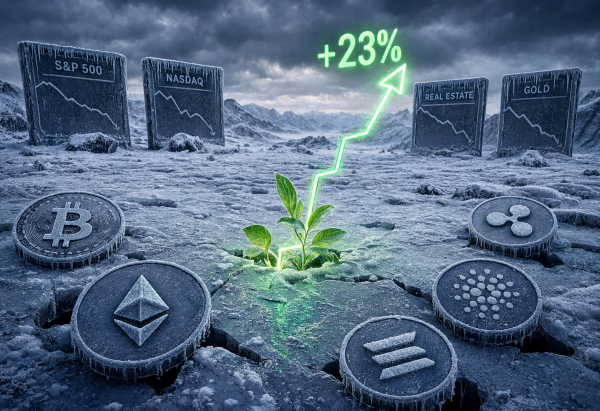
The report said overall cryptocurrency prices fell 36 percent in the first half, the weakest performance among major asset classes. By contrast, the Bitwise Crypto Innovators 30 Index, made up of 30 listed stocks tied to the crypto ecosystem, returned 23 percent over the same period. Bitwise said that outperformed most major asset classes excluding emerging market stocks, and delivered more than double the return of U.S. stocks.
Bitwise pointed to changes in the industry structure behind the divergence. Bitcoin mining companies benefited from rising data-centre demand driven by the expansion of AI infrastructure, and companies tied to stablecoins and real-asset tokenisation also sustained growth on the back of expanding institutional investment.
Rasmussen said cryptocurrencies are not a single asset but an ecosystem made up of multiple industries. He said that is why it is difficult to judge the entire industry by price alone.
Within the industry, performance improvements in DeFi services stood out. The combined revenue of the top 10 DeFi applications over the past 12 months came to $5.9 billion. Decentralised exchange PancakeSwap recorded about $923 million, derivatives exchange Hyperliquid about $912 million, and lending protocol Aave about $877 million in revenue. Bitwise said these services are building business models that generate real revenue even in a bear market.
The RWA market also continued to grow. The market size in the second quarter reached a record $33 billion. Backed by expanded tokenisation of U.S. Treasuries and corporate bonds, stocks and venture capital assets, it grew 12 percent from the previous quarter and 45 percent from the start of the year. Rasmussen analysed the trend, saying the world's largest asset managers are moving in earnest to bring assets on-chain.
Prediction markets also expanded rapidly. Second-quarter open interest hit a record $1.8 billion, and quarterly trading volume also set an all-time high of $43 billion. Sports-related prediction markets accounted for the largest share, and services such as Polymarket were cited as representative cases in which users use the service without directly being aware of cryptocurrency. Bitwise forecast that as the U.S. midterm elections draw nearer, prediction-market trading volume and open interest could set new records again.
An analysis also said related stocks showed differentiation from an investment portfolio perspective. Bitwise said its analysis of the 90-day rolling correlation of its crypto-related stock index found lower correlation with developed and emerging market stocks, U.S. REITs, U.S. Treasuries and gold than with U.S. stocks. Bitwise said related stocks not only posted higher returns than the U.S. stock market in the first half, but also provided diversification benefits.
Ultimately, the first half of this year is seen as an example showing that cryptocurrency prices and the industry's growth do not necessarily move in the same direction. Prices were weak, but improving DeFi profitability, expanding real-asset tokenisation, growth in prediction markets and continued expectations for related companies' performance produced differing growth trends within the cryptocurrency industry, the analysis said.
 Jinju Hong
hongjj@d-today.co.kr
Jinju Hong
hongjj@d-today.co.kr