
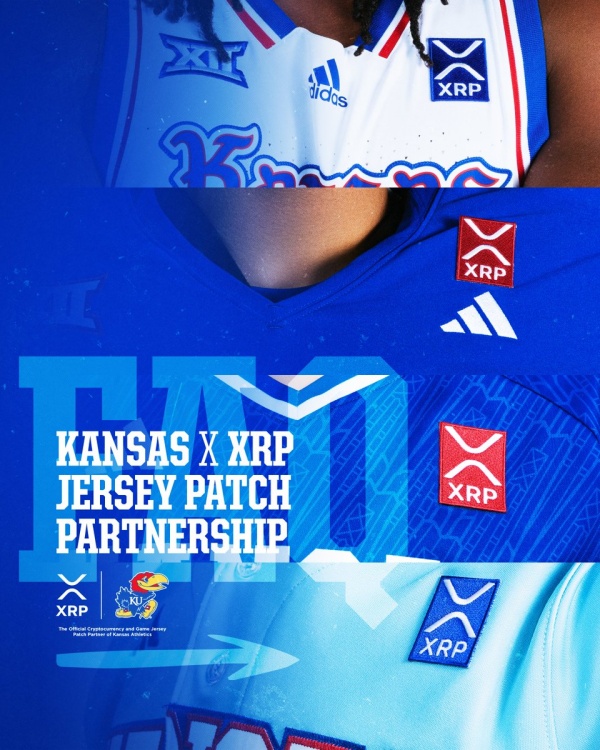
A debate is growing over how far Kansas University should allow cryptocurrency advertising after the XRP logo appeared on the school’s sports team uniforms.
Blockchain outlet U.Today reported on July 15 that David Schwartz said calls to ban XRP advertising would be difficult to sustain under the U.S. Constitution.
The controversy began after Kansas University’s athletic department announced a partnership with Ripple. As the XRP logo appeared on Kansas Jayhawks uniforms, critics on social media called for a blanket ban on promoting digital assets to students. Some opponents argued cryptocurrency ads should be grouped with gambling, tobacco and alcohol advertising and kept out of sports.
Schwartz put the issue of free speech at the forefront. He said governments in the West generally do not ban advertisements for legal commerce on campus, and that the key distinction is that if a product can be sold legally, its promotion is also allowed under the constitution.
Schwartz in particular stressed that the U.S. Constitution’s First Amendment also protects commercial free speech. He also said the government cannot suppress truthful commercial speech simply because it can regulate other areas more strictly, and cannot block it simply because the public might make legal but bad choices.
U.S. Supreme Court precedents were also cited, including 44 Liquormart v. Rhode Island on limits on liquor advertising and Greater New Orleans Broadcasting v. United States on regulation of casino advertising. In light of that line of cases, Schwartz said if XRP is legal, blocking advertising without a substantial constitutional basis could come close to direct censorship.
The debate is spreading beyond sponsorship marketing into a broader question of norms at the intersection of college sports and the cryptocurrency industry. Brad Garlinghouse (브래드 갈링하우스), Ripple’s chief executive officer, is a Kansas University alumnus and was reported to have personally regarded the partnership as a meaningful milestone. Outside the market, voices questioning the appropriateness of student exposure are growing louder.
The core issue is XRP’s legal status and the limits of advertising regulation. Schwartz said as long as XRP is officially recognized as a commodity, attempts to restrict its promotion could be judged by courts as a violation of free speech. The debate is shifting beyond arguments over the appropriateness of cryptocurrency advertising to how far commercial advertising for legal products can be limited on college campuses.
"The United States has the First Amendment. If you want to restrict or can speech, you need to find some exception it fits into. I don't think there is one here. See the cases I cited including one involving liquor and one involving gambling."
 Yoonseo Lee
yslee@d-today.co.kr
Yoonseo Lee
yslee@d-today.co.kr