
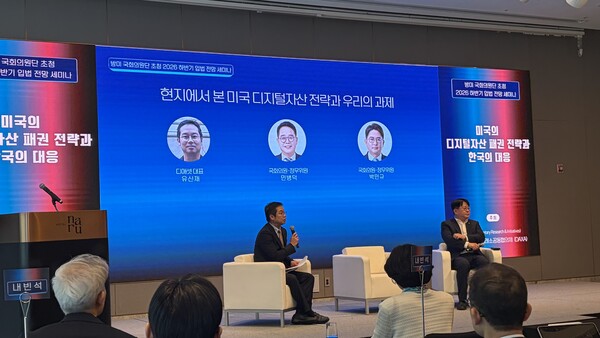
The ruling party is expected to reorganise its digital asset task force (TF) after the August party convention and resume discussions in September on the Digital Asset Framework Act.
At a seminar in Mapo-gu, Seoul on July 15 titled "U.S. digital asset hegemony strategy and South Korea's response", Democratic Party lawmaker Park Min-gyu (박민규) said that once a policy committee chief is appointed after the August convention, the party will newly form the digital asset TF and, after party-government consultations, push to introduce the bill. "There needs to be visible movement in September," he said.
Park said the biggest takeaway from a recent trip to the United States was the atmosphere of pursuing digital assets at the level of national strategy.
He said the White House, Congress, regulators and companies were in continuous communication to design institutions and industry together, and that the strategy to expand the dollar's influence through stablecoins was clear.
"Korea also needs to approach this not simply as coin regulation but from the perspective of future financial infrastructure and industrial competitiveness," he said.
He stressed that as the U.S. digital asset market structure is rapidly expanding, domestic legislation must not be delayed further.
He said passing the Digital Asset Framework Act would make it possible to prepare enforcement decrees, overhaul follow-up systems and expand token securities (STO) and various on-chain financial services. He added that there are not a few cases where banks and companies have already invested in related infrastructure but cannot use it because the bill is delayed.
The key sticking points in current talks are who can issue stablecoins and rules on exchange ownership stakes. A government draft reviewed an option for banks to hold 50 percent plus 1 share or more of an issuer, but differing views within the Democratic Party TF delayed the bill's processing.
"The debate over the issuer is only the start of the overall system," Park said. "We need to discuss this together with the follow-up ecosystem and industrial promotion."
In the industry, views were also raised that system design must not remain limited to issuance eligibility.
Kim Jong-seung (김종승), CEO of MRI, said the talks are focused on bank equity requirements, but the real stability of stablecoins depends more on a structure that can maintain and restore value (the peg) in a crisis.
He said the bill should also include re-restoration mechanisms such as redemption systems, crisis response devices and joint funds, not only the size of reserve assets.
Han Seo-hee (한서희), a lawyer at law firm Lee & Ko, analysed that the United States is using stablecoins not merely as a payment tool but as a strategy to expand dollar hegemony and the digital finance ecosystem.
She suggested that as U.S. rules are completed, their influence in global markets is likely to grow, and South Korea also needs a strategy that can foster won-denominated stablecoins, token securities and the digital asset ecosystem together.
Park said the Digital Asset Framework Act is not a law that ends with deciding who can issue stablecoins, but a starting point for building an industrial ecosystem. He added that he will do his best to restart the TF in September, introduce the bill after party-government consultations, and ensure institutionalisation is achieved within the year.
 Oh Sang-yeop
yub@d-today.co.kr
Oh Sang-yeop
yub@d-today.co.kr