
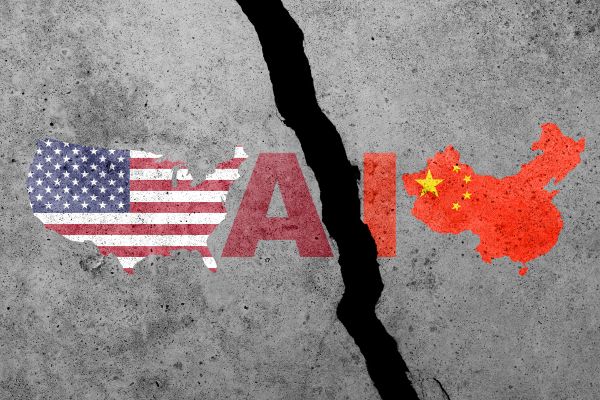
OpenAI and Google have provided AI services to overseas units of Chinese companies placed on a U.S. Defense Department watchlist. The targets included Singapore entities linked to Alibaba, Baidu and Tencent Holdings.
Cryptopolitan, a blockchain media outlet, reported on July 10 that the key issue is that U.S. AI rules targeting China focus on semiconductor exports, while the provision of finished AI models as online services is relatively unregulated. Washington restricts shipments of high-performance chips needed to develop cutting-edge AI systems. It has not put in place comprehensive blocking measures when those systems are delivered over the internet. As a result, even when a parent company is on the U.S. Defense Department watchlist, access to U.S. AI models remains possible through overseas units registered in permitted markets such as Singapore or Hong Kong.
The U.S. Defense Department's 1260H list is a monitoring system that identifies Chinese companies that could support the People's Liberation Army. Being included on the list does not fully block purchases of advanced U.S. software products. The outlet reported that the United States has restrictions on some software products, including OpenAI's GPT-5.6 and Anthropic products such as Mythos and Fable. It said there is no general rule that blocks Chinese companies from using U.S. AI online services overall.
OpenAI last month cut off access for API users linked to Alibaba. The company confirmed the account suspensions this week. OpenAI said it had detected signs that the accounts engaged in activity that may have violated its rules. The conduct cited was distillation. This involves collecting large amounts of responses from one AI system and using them to improve the performance of another model.
OpenAI said it notified U.S. authorities about the related activity. It said its models cannot be used in mainland China, but it continues to provide services to some companies owned by Chinese nationals in other countries where it can control activity. The company added that customers say they can operate in countries where it can enforce safeguards and monitor distillation, and that access should not be decided by nationality alone.
The case also shows market realities in which U.S. companies are blocking China while Chinese companies use U.S. AI at the same time. In Silicon Valley, Chinese models from DeepSeek and Moonshot AI are spreading for general business use, and are being used as substitutes for OpenAI and Anthropic services on the back of lower prices. Some companies are reported to be running Chinese and U.S. models together depending on the task.
Inside China, changes in sentiment are also being detected over the scope of AI technology disclosure. China has viewed the overseas spread of its AI models as a way to expand global influence and has distributed many leading models in open-code form. Recently, discussion has been under way on strengthening protection of key AI research results and technologies. The concern is that rival governments, criminal organisations or hostile forces could take important technology and use it in ways that disadvantage China.
Western AI companies are also raising concerns about technology leakage from China. Anthropic claimed that DeepSeek, Moonshot AI and MiniMax attempted distillation against its products. In a letter submitted to Congress last month, Anthropic said Alibaba created 25,000 fake accounts and interacted with Claude more than 28.8 million times. The company said the activity violated its service rules.
The case again showed that a regulatory gap remains in U.S. AI controls targeting China between chips and cloud-based AI services. The focus ahead is on whether the United States will further restrict indirect access through overseas units, and what standards U.S. AI companies will apply between country-by-country controls and commercial service provision.
 Jinju Hong
hongjj@d-today.co.kr
Jinju Hong
hongjj@d-today.co.kr