
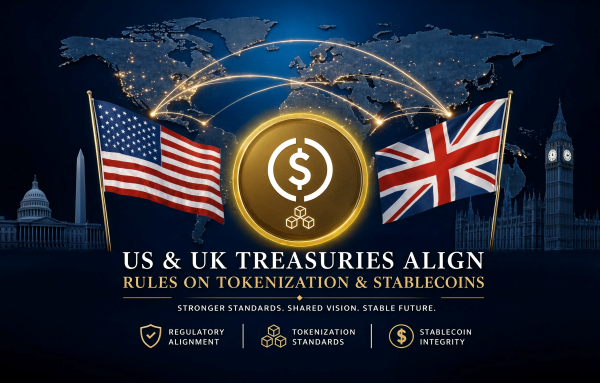
[DigitalToday reporter Jinju Hong (홍진주)] U.S. and British finance authorities have moved to align regulation on tokenised assets and stablecoins.
Cointelegraph, a blockchain outlet, reported on July 14 that the U.S. Treasury Department and Britain’s Treasury issued 4 recommendations on digital assets as part of a “Transatlantic Taskforce for the Future of Markets”.
The recommendations have 2 main pillars. One is to create a cooperative framework to test cross-border use of tokenised assets. The other is to set common regulatory principles for the stablecoin market. The two finance authorities proposed considering a privately led consultative body to test use cases for cross-border use of tokenised assets. They also recommended that U.S. financial authorities and the Bank of England find a common approach to regulating tokenised assets.
On stablecoins, the recommendations also directly mention building a cross-border market alongside regulatory alignment. The joint statement set the goal of building a “dynamic cross-border stablecoin market”. The two governments also said they would design their own systems but align standards so similar risks and activities produce similar outcomes. The joint statement said, “Each government will design requirements in a way that pursues comparable outcomes for similar risks and activities, while enhancing financial stability and avoiding market distortion or reduced cross-border competition.”
Reserve-asset standards also aligned with the direction of U.S. legislation. The recommendations specify that stablecoins must be “fully backed by high-quality liquid assets at a minimum 1-to-1 standard”. A U.S. Treasury statement did not directly mention the Genius Act, a law related to payment stablecoins enacted last year, but the wording shows the same direction as the U.S. system that is awaiting approval of detailed rules ahead of implementation in January 2027.
The announcement also ties into discussions in Britain on fostering the tokenisation industry. An industry task force backed by the British government previously said annual economic output could increase by as much as $44 billion by 2035 if Britain becomes one of the leading jurisdictions in tokenisation, tokenisation spreads globally and adoption in Britain rises to the level of major competitor countries.
Policy discussions in Britain have also presented an implementation timetable. The industry task force called for issuing tokenised bonds by the first quarter of 2027 and pushing ahead with tests of blockchain-based financial transactions. Against this backdrop, the joint U.S.-UK recommendations link to a move to pursue both real-world testing of tokenised finance and institutional preparation at the same time.
A key point to watch is whether coordination on systems leads to actual regulatory text and market experiments. The United States is preparing to implement a law on payment stablecoins, and Britain is preparing tokenised bonds and tests of blockchain transactions. As a result, the next stage is expected to be how far the two sides align common standards and whether privately led cross-border experiments expand into actual market infrastructure.
 Jinju Hong (홍진주)
hongjj@d-today.co.kr
Jinju Hong (홍진주)
hongjj@d-today.co.kr