
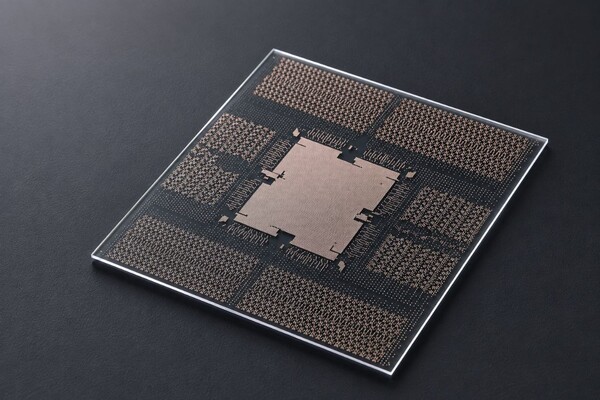
JNTC, which is seeking to gain an early foothold in the glass substrate market, has built a commercialisation cooperation framework with a Japanese semiconductor packaging company. JNTC said on Sunday it signed an agreement with TOPPAN to commercialise TGV glass substrates, a next-generation semiconductor packaging product. TGV glass substrates use a technology that drills holes in glass substrates to pass electrical signals.
JNTC previously announced on June 19 that it had succeeded in developing TGV glass substrates with glass thicknesses ranging from 0.3 mm to 2.0 mm. The agreement with TOPPAN is a supply-chain expansion step based on that result. The company said it has already signed MOUs and NDAs with multiple global companies at home and abroad.
A company official said it had become the first in the industry to have a multi-lineup spanning glass thicknesses from 0.3 mm to 2.0 mm. The official said the 2.0 mm product was implemented with a single 2.0 mm sheet of solid glass rather than a process that bonds two 1.0 mm glass sheets, which is being reviewed in the industry, and that the company has secured a mass-production yield of about 94%. The company added it has secured key commercialisation element technologies such as Micro-Crack Free, defect-free bonding and warp prevention, and that productivity and price competitiveness are also receiving high evaluations from customers.
The company said that in about 2 years after formally declaring its entry into the semiconductor glass substrate business in 2024, it has completed vertical integration across the entire pre-production process for TGV glass substrates. It said it is now looking through to the commercialisation stage with multiple global companies based on verified technological capabilities.
Chief Executive Nam-hyeok Cho (조남혁) said the company is currently carrying out various projects and evaluations with global comprehensive semiconductor companies and semiconductor packaging firms in Greater China, Japan, Europe and South Korea for mass production in 2027. He said it plans a strategic expansion of mass-production lines in South Korea rather than Vietnam to respond quickly to global customers' demand for high-difficulty customised products, and that it has made a decisive move to pre-empt and standardise the global glass substrate market through its recently completed development and manufacturing technology for 2.0 mm-thick glass.
 Dae-geon Seok
d2dg@d-today.co.kr
Dae-geon Seok
d2dg@d-today.co.kr