
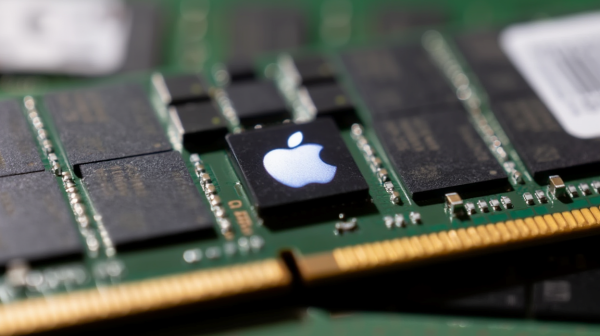
Apple’s contract for Intel to manufacture semiconductors in the United States played a key role in the company securing an exemption from import tariffs on semiconductors last year, it has been reported. The decision to produce some chips for next-generation Macs and iPhones at Intel’s U.S. plants was seen as dovetailing with the tariff waiver.
On July 11, local time, IT outlet NineToFiveMac reported that The Wall Street Journal said Apple avoided the tariff burden on imported semiconductors by presenting plans to produce semiconductors in the United States.
The report said the Trump administration effectively presented Apple’s use of Intel’s U.S. production facilities as a key condition for tariff exceptions. Apple later adjusted its supply chain strategy to expand manufacturing cooperation with Intel, and it did not face import tariffs on semiconductors as a result.
That meant Apple did not have to pass tariff costs on to consumers through higher prices. The Wall Street Journal said Apple did not need to raise Mac or iPhone prices because of semiconductor tariffs. It meant the push to expand U.S. production was a choice aimed at responding to trade policy, beyond simply diversifying the supply chain.
Solving the tariff issue did not fully eliminate cost pressures. Apple later faced a new variable: a global shortage of memory supply. It avoided import semiconductor tariffs, but rising memory prices and supply disruptions persisted, keeping manufacturing costs under pressure in a different form.
The case shows Apple’s semiconductor procurement strategy is closely linked not only to production efficiency but also to U.S. industrial and trade policy. If some chips for next-generation Macs and iPhones are produced at Intel plants in the United States, Apple’s semiconductor supply chain could shift toward partial dispersion from a structure centered on overseas production.
The market is also producing analysis that the deal could be a meaningful turning point for both Apple and Intel. Apple could reduce geopolitical risks and tariff burdens, while Intel could expect the benefit of securing a major customer as it expands its foundry business.
Industry attention is focused on how much Apple will expand the share of production in the United States. With conditions likely to persist in which supply chain stability and tariff risks must be managed at the same time, Apple’s strategy to diversify production bases is expected to become a core pillar of its future semiconductor procurement policy.
 Jinju Hong
hongjj@d-today.co.kr
Jinju Hong
hongjj@d-today.co.kr