
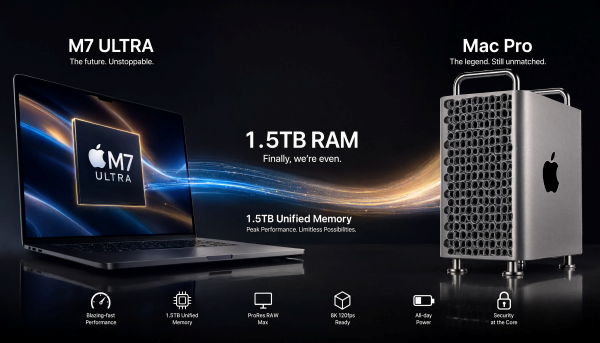
Apple is said to be preparing a next-generation M7 Ultra chip with a unified memory (RAM) configuration of up to 1.5 TB. If released as an actual product, Apple silicon-based Macs would reach the same level as the top memory specification of the 2019 Intel Mac Pro.
On July 12, IT outlet 9to5Mac reported that Bloomberg's Mark Gurman (마크 거먼) wrote in a newsletter that Apple is preparing support for up to 1.5 TB of unified memory on the M7 Ultra chip.
Gurman added that the configuration may not be released as an actual product because of an ongoing memory supply shortage. Still, the M7 Ultra itself is said to be designed to support up to 1.5 TB of memory.
The plan is interpreted as a move to significantly expand memory limits for Apple silicon Macs. Apple has adopted a unified memory architecture that integrates the CPU, GPU and memory into a single chip to deliver high bandwidth and power efficiency. But because expanding memory capacity directly affects chip design, it has been cited as a constraint in the professional market that wants ultra-high-capacity configurations.
A change in product strategy has also emerged recently. Earlier this year, Apple removed the 512 GB memory option on the M3 Ultra-based Mac Studio and then discontinued the 256 GB configuration. The current top-spec Mac Studio has 96 GB of unified memory, and the M4 Max model can be configured up to 128 GB. With the range of memory options for top-performance products having narrowed, the M7 Ultra's ultra-high-capacity memory support is seen as a strategy to target the professional market again.
Apple is set to introduce the M5 Ultra chip later this year. The industry expects the M5 Ultra to support up to 768 GB of unified memory. If the M7 Ultra supports up to 1.5 TB, Apple silicon Macs' limit on memory expansion is expected to rise another step.
The price is expected to be substantial. Based on Apple's current memory upgrade policy, calculations suggest the additional cost of expanding from a 128 GB base configuration to 1.5 TB could exceed $35,000. The actual sales configuration and price have not been disclosed, but it is likely to be an option aimed at demand for ultra-high-performance workstations such as AI development, large-scale data analysis and video production rather than general consumers.
Industry attention is focused on whether Apple will release the configuration as an actual product. While the possibility remains that plans could change depending on the memory supply situation, the fact that Apple is preparing the M7 Ultra to support up to 1.5 TB of memory alone has prompted assessments that Apple silicon has entered a stage of effectively closing the gap with the Intel-based Mac Pro in terms of memory capacity.
 Jinju Hong
hongjj@d-today.co.kr
Jinju Hong
hongjj@d-today.co.kr