
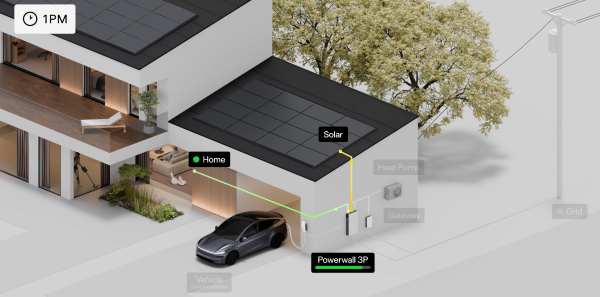
Tesla has launched Tesla Home, a household energy management platform.
On July 8, electric vehicle outlet Electrek reported that Tesla Home is a service that helps households cut electricity bills by making hundreds of daily decisions on power storage and use based on an AI engine called Opticaster.
The core of the launch is not entirely new hardware, but bundling Tesla’s existing energy products and software into a single consumer interface. According to Tesla’s support page, Tesla Home controls home batteries and solar, a Wall Connector and smart breakers to optimise power consumption and increase energy savings. Existing Powerwall users can use it without additional hardware.
Users can choose an operating mode depending on their goals. Selecting savings minimises costs in line with the electricity rate structure, while selecting self-powered can be set to prioritise stored solar power after sunset. In the Tesla app, users can see what decisions the system made and why it made those choices.
Opticaster, the actual engine, is not a new product. Tesla introduced Opticaster as an AI engine for smart energy management that runs on all Powerwalls. The software forecasts solar generation and household loads, then draws up customised operating strategies based on user-set goals.
Tesla stressed that Opticaster has already built large-scale operating experience in the field. The company said Opticaster has accumulated more than 100 million hours of operational experience. It also said it delivered tens of millions of dollars in value to thousands of customers worldwide through operating cost reductions and grid services revenue. The software has also been applied to Tesla’s utility-scale energy storage systems and virtual power plants, and was used in 2024 to pay about $10 million, or about 15.04 billion won, to Powerwall owners.
What is actually new in this change is the app experience. Tesla app version 4.58.6 integrated energy-related settings that had been scattered into a “Home Control” menu. Backup reserve power, off-grid mode and operating modes are now in one place, and the settings structure was reorganised into home settings, product information and site configuration.
The update also added smart breaker integration to the app. Users can control individual circuits and choose which loads to maintain in a blackout. The Home Status function uses AI to summarise what the system is doing and why. A rate-plan-based charging feature that aligns electric vehicle charging to low-price periods works when using a third-generation Powerwall or a Universal Wall Connector.
Tesla Home largely repackages existing functions under a new name. Tesla is expanding connectivity within its energy ecosystem, linking Powerwall, solar panels, Solar Roof, Wall Connector and Eaton’s AbleEdge smart breaker. Offering it to existing customers without additional equipment also aligns with that strategy.
The key point to watch is whether the effects of Opticaster, proven in commercial and grid areas, will be felt at the same level in households. Tesla has shifted Tesla Home so consumers can manage goal-based energy use from a single dashboard, but actual savings may vary depending on each household’s electricity rate system and equipment configuration.
 Seung-ah Yoo
ysah@d-today.co.kr
Seung-ah Yoo
ysah@d-today.co.kr