
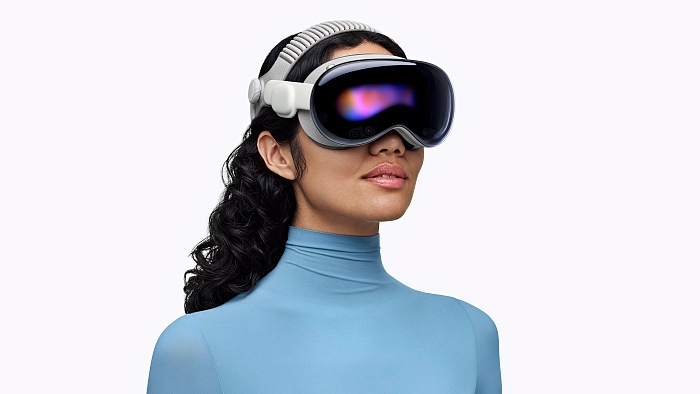
Apple has been reported to have put the brakes on development of an extended reality (XR) device it had been considering as a lower-cost follow-up to the Vision Pro. With panel development halted, expectations are growing that Apple is placing more weight on developing AI smart glasses than on a spatial computing headset.
IT media outlet NineToFiveMac reported on Tuesday that Samsung Display has fully halted its G-VR panel development project that was set to be used in Apple’s low-cost XR device.
The G-VR panel is reported to be a display Apple had been considering for a mass-market XR device with a price sharply lower than the existing Vision Pro. The industry had expected mass production to start after 2028. But Apple has scaled down the project since early this year and shifted the central focus of its next wearable device to AI smart glasses, and Samsung Display has also ended parts development, it was reported.
The news again puts the brakes on years of expectations for a launch of a “low-cost Vision Pro.” The industry has consistently raised the possibility that Apple is preparing a model that is lighter and cheaper than the Vision Pro, but the supply chain has recently sent conflicting signals.
Bloomberg reported in October last year that Apple had temporarily suspended its Vision Pro follow-up project and reassigned development staff to smart glasses. Mark Gurman also forecast that development of a successor headset to the existing $3,499 Vision Pro is continuing, but it would be difficult for the launch timing to be before late 2028 or 2029.
Apple analyst Ming-Chi Kuo has also recently analysed that only smart-glasses products can be confirmed on Apple’s product roadmap, while plans related to an existing immersive headset are effectively not visible. He assessed that, compared with the schedule he had expected a few months ago, Apple’s internal priorities appear to have shifted to smart glasses.
Some interpretations also say Apple has not abandoned its spatial computing strategy itself. In a recent interview, Apple’s global vice president of marketing Greg Joswiak described the Vision Pro as a product that brings forward a future in which the digital world and the real world are combined. Hardware engineering chief John Ternus also stressed that delivering a high-quality user experience is more important than rushing new technology to market.
That suggests Apple is viewing the Vision Pro not as an immediate mass-market product but as the starting point for a long-term spatial computing platform. The Vision Pro itself, from the beginning, was focused on presenting a future computing environment rather than on large-scale sales.
But recent moves seen in the supply chain are adding weight to the possibility that AI smart glasses will, for the time being, sit at the centre of Apple’s next wearable strategy. With development of key components for a low-cost XR headset halted, Apple is more likely to concentrate resources in the short term on developing AI smart glasses suitable for everyday wear rather than on a headset, analysts said.
A key point to watch will be whether Apple maintains the Vision Pro line as a long-term project while also moving to fully foster AI smart glasses as a new growth axis in the next wearable market.
 Jinju Hong
hongjj@d-today.co.kr
Jinju Hong
hongjj@d-today.co.kr