
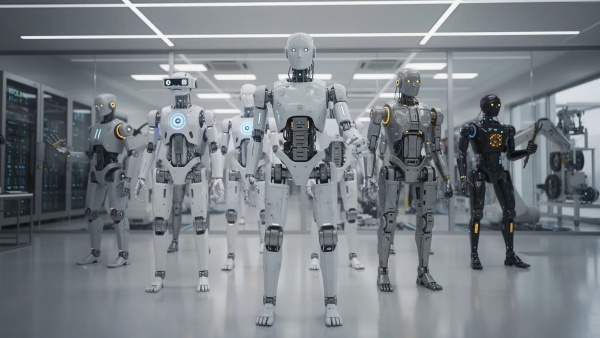
[DigitalToday reporter Jinju Hong] The robot industry is expected to move beyond developing separate artificial intelligence for each device and reorganise around large, general-purpose AI models that can be commonly applied to a variety of robots. Some argue that companies building "physical AI foundation models," rather than robot makers, could determine future competitiveness.
TechCrunch reported on Tuesday that robot AI startup General Intuition said the current method of developing a separate AI model for each robot is likely over the long term to be replaced by general-purpose foundation models.
The company's core strategy is to build a general-purpose model using high-quality data that can learn human intuition about space and time, movement and interaction, instead of collecting massive amounts of real robot data.
General Intuition CEO Pim de Witte (핌 더 비테) said the industry is currently focused on AI development tailored to "individual implementations, individual environments, individual robots." He explained that once a general-purpose model takes hold, much of that work could be duplicated.
To that end, General Intuition used millions of hours of video game data for training. It said it trained reasoning ability about space and time using behavioural data that included which buttons users pressed in which situations during gameplay.
De Witte and major investor Vinod Khosla see such behavioural data as a key factor in forming the basic intuition robots need to understand the real world.
The company also applied the model it trained to a real robot. In a demonstration, it said it succeeded in operating a quadruped robot after fine-tuning the general-purpose model with just 8 minutes of real robot data. The robot moved through an office environment using only a front-facing camera, without separate LiDAR or special sensors. The company said it showed "zero-shot" performance, operating immediately without additional learning even as people passed by and objects kept changing.
De Witte said "the model's generalisation ability itself is the product." He said that once basic reasoning ability about space and time is secured, companies will no longer need to collect hundreds of thousands of hours of real robot data. He added that just a few minutes of data is enough.
The market is also paying attention to the strategy. General Intuition recently raised $320 million in funding at a valuation of $2.3 billion. The company plans to focus the funds on developing physical AI foundation models rather than manufacturing robots.
Its business direction also differs from that of typical robot makers. General Intuition aims to be a platform company that provides AI foundation models that other robot companies can use in common, rather than selling its own humanoid or industrial robots.
"We will not build a self-driving car company," de Witte said. "The goal is to make it 10 times easier for other companies to build self-driving car companies," he explained.
The industry sees this approach as a potential signal that the axis of competition in robotics could shift from hardware to software and data. Still, a key task going forward is whether General Intuition's model can prove the same level of generalisation across different manufacturers and robots and in real industrial settings.
 Jinju Hong
hongjj@d-today.co.kr
Jinju Hong
hongjj@d-today.co.kr