
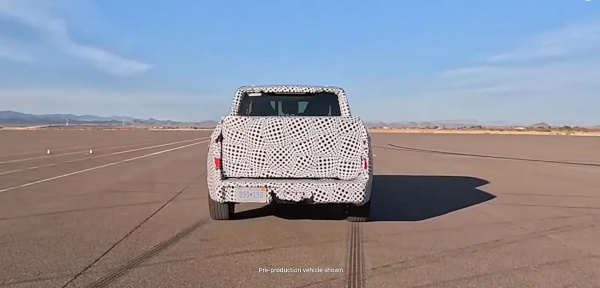
Ford is changing the planned vehicle class of its electric pickup expected to launch in 2027, shifting it from “midsize” to “small” as it accelerates its push into the mass-market EV segment. The move is seen as a strategy to target a new electric pickup market by emphasizing low prices, production efficiency and space utilization.
Electrek reported on July 8 that Ford recently described the vehicle, while outlining plant investment plans, as a “completely new, reasonably priced small electric pickup.” That differs from the company’s prior practice of consistently introducing the model as a “midsize electric pickup.” It has prompted an interpretation that Ford is starting to reflect body size and product positioning more realistically.
The model is the first mass-produced vehicle to use Ford’s newly developed EV-only UEV (Universal Electric Vehicle) platform. It targets a 2027 launch, with a starting price expected at about $30,000.
In a recent second-quarter earnings release, Ford said it is converting its Louisville Assembly Plant in the United States into a production base for a “reasonably priced small electric pickup,” while explaining a sales decline tied to the end of production for certain models. It again stressed that it is upgrading equipment at the same plant to produce a small four-door electric pickup based on the UEV platform.
Its size has also started to take shape through recently spotted test vehicles. A camouflaged test vehicle parked next to the full-size Expedition sport utility vehicle was confirmed to have a much smaller and lower body than existing midsize pickups. The industry is focusing on the possibility that Ford has shifted toward a smaller class than originally planned.
The model name has not been disclosed, but the possibility has been raised that Ford could revive a past nameplate as an electric pickup after it recently filed a trademark application for “Ranchero.”
The new vehicle also represents Ford’s next-generation EV strategy. The company plans to apply lithium iron phosphate (LFP) batteries and megacasting to cut costs, and to reflect the resulting savings in the selling price.
Ford also plans to sharply simplify manufacturing. The company said the new platform uses only 2 major structural casting parts. That is a drastically simpler design compared with the 146 structural parts used for current Maverick production. The strategy is to reduce parts to secure both productivity and cost competitiveness.
Ford also highlighted interior space as a competitive edge. It said it can secure more interior space than the Toyota RAV4 by using a flat battery-pack structure. It added that the comparison is based on passenger space, excluding the cargo bed and front storage space, or frunk.
It is targeting a driving range of at least 300 miles, or about 483 km. Ford aims to target the mass-market electric pickup segment by achieving both a price of around $30,000 and a range of more than 300 miles.
The industry views the model as a turning point for Ford’s EV strategy. As the first mass-produced vehicle on the UEV platform and the company’s first electric pickup emphasizing price competitiveness, the final price, vehicle size, product competitiveness and production efficiency are expected to be key factors determining market competitiveness at the time of launch.
 Jinju Hong
hongjj@d-today.co.kr
Jinju Hong
hongjj@d-today.co.kr