
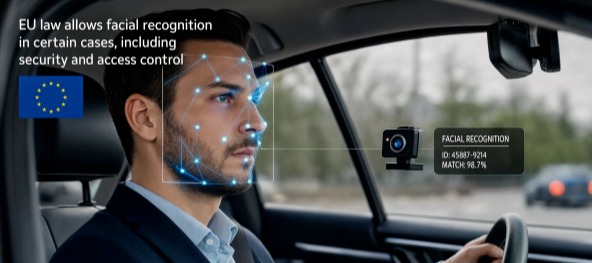
The European Union has made it mandatory for all new cars sold to have cameras that monitor a driver's face direction in real time. The move aims to reduce drowsy driving and distraction-related accidents, but concerns are also being raised that how drivers' gaze and video data are handled is unclear.
On July 9 local time, online media outlet Gigazine reported that the EU has mandated the installation of an Advanced Driver Distraction Warning (ADDW) system in all new cars sold from July 7.
ADDW uses an infrared camera mounted around the steering wheel or dashboard to track a driver's face and gaze direction in real time. If the driver looks away from the front for longer than a certain period, such as looking at a smartphone or checking the back seat, warning lights, sounds and vibrations prompt the driver to pay attention.
The system automatically operates at speeds above 20 km per hour. A warning is triggered if the driver's gaze leaves the road for about 3.5 seconds at high speeds or about 6 seconds at lower speeds. The EU expects the system could save more than 25,000 lives by 2038.
Drivers' reactions are mixed. A test by Belgian automotive outlet Gocar.be found that warnings were triggered frequently even in normal driving conditions. It said alerts sounded even when a driver briefly looked around on an empty highway or adjusted the car audio.
Some users reported similar experiences. A driver who test-drove a Ford Puma said they received a prompt recommending a break just 10 minutes after starting to drive, followed by repeated stronger warning sounds and warning lights. The driver also cited as an inconvenience that the function automatically reactivates when the car is restarted even if it is turned off.
The biggest issue is privacy protection. Under EU rules, ADDW must not be a system for biometric identification and must operate in a "closed loop" manner in which data is processed only inside the vehicle. That means driver video or gaze data must not be transmitted to external servers or carmakers.
But how data is actually processed remains unclear. Critics say no detailed verification system has been put in place on how driver video is analysed, how long data is stored and when it is deleted. The EU General Safety Regulation bans data retention beyond what is necessary for the purpose, but it is not clear how far "necessary" extends for ADDW.
Such concerns also connect with past cases in the auto industry. In 2024, it emerged that some automakers, including GM, Honda, Hyundai Motor and Kia, shared driving data with data brokers and provided it to insurers, sparking controversy. Some consumers saw their insurance premiums rise as driving habits were used to calculate premiums.
There are also concerns about leaks of video data. In a 2023 Reuters investigation, some former Tesla employees were reported to have shared customer vehicle camera footage on an internal messaging system, putting vehicle camera data management under scrutiny.
In the EU, the General Data Protection Regulation applies, and face and gaze information is also protected as personal data. Automakers must collect only the minimum necessary information and delete it once the purpose has been fulfilled, but it has not yet been confirmed how faithfully ADDW follows these principles in practice.
The industry shares the policy intent to prevent accidents by reducing driver distraction, but it also sees that an in-vehicle monitoring system that operates at all times could lead to a new privacy controversy. Setting up an independent oversight system to verify whether data is stored, retention periods, deletion methods and whether data is transmitted externally is expected to emerge as a key task going forward.
 Jinju Hong
hongjj@d-today.co.kr
Jinju Hong
hongjj@d-today.co.kr