
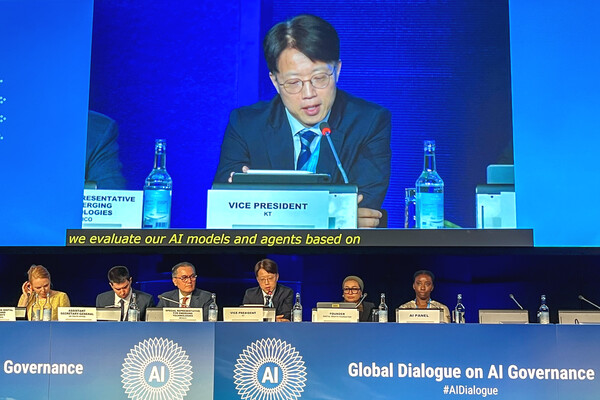
KT joined international events to discuss responsible AI and ways to cooperate on global AI standards.
KT said on July 9 it took part in a roundtable session, "AI Foundations: Digital Trust and AI Infrastructure for All," at the AI for Good Global Summit held in Geneva on July 7 local time.
The session was hosted by the ITU Telecommunication Standardization Bureau, the United Nations' specialised agency for information and communication technologies. Key decision-makers from industry, governments and standards bodies discussed digital trust in the agentic AI era and AI infrastructure for all.
KT presented ways to secure "trust primitives" needed in the agent AI era. Trust primitives refer to "identity" that indicates whose agent it is, "consent" meaning the scope of permission, and "verifiability" meaning provability.
KT assessed that traffic, previously centered on people and systems, is moving to agents. It stressed that a trust system based on identity, consent and verifiability is needed for agents to act safely. It also said such a system should be built on open interoperable standards and neutral trust infrastructure that can operate beyond companies and borders.
KT also took part in the UN-hosted Global AI Governance Dialogue on the same day to discuss best practices and cooperation on AI governance. Launched last year, the dialogue is a forum for governments and stakeholders to discuss international cooperation for safe and inclusive AI.
In a breakout session on "Respect, Protect and Promote Human Rights: Transparency, Accountability and Human Intervention," KT stressed that the UN's established human rights principles must be equally guaranteed in the process of AI development.
Park Wan-jin (박완진), an executive director in charge of tech strategy at KT AX Future Technology Institute, said, "In an era when agents replace people, it is important to guarantee human rights and build interoperable digital trust." He added, "KT will responsibly contribute to discussions on global standards as an operator that can provide neutral trust infrastructure while also developing AI models directly."
 Jin-ho Lee (이진호)
jhlee26@d-today.co.kr
Jin-ho Lee (이진호)
jhlee26@d-today.co.kr