
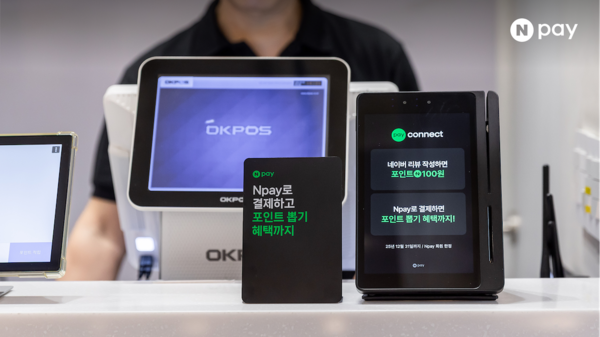
Competition in offline payment terminals is heating up, led by face-payment services. Interest in face payment has risen since last month’s “three CEOs meeting,” where Jensen Huang and the heads of major companies gathered. Toss and Naver Pay have begun a full-scale race to expand affiliated merchants.
Industry officials said on July 9 that face payment has been spreading rapidly since the June 5 “three CEOs meeting.” At the time, Lee Hae-jin (이해진), chairman of Naver’s board, made a payment using FaceSign, a facial-recognition payment service, through the company’s Npay Connect. After that, Naver Pay’s weekly number of new face registrations jumped 193% from the previous week. Over the same period, the number of transactions and the value of payments rose 121% and 204%, respectively.
◆ Easy-payment rivalry spreads beyond apps
Competition in easy payments has mainly played out inside mobile applications. Key factors were user numbers, transfer convenience, point rewards and partner discounts. Face payment works differently. Even if users register, it is hard to use in practice if stores do not have terminals that support the payment method.
As a result, Toss and Naver Pay are focusing on expanding the number of merchants with installed terminals while increasing face-payment users.
Terminals are more than just payment tools. They serve as contact points linking offline stores with platforms. Depending on which terminal is installed, not only payment methods but also reviews, coupons, rewards, ordering and store-management functions can be bundled together.
For platforms, rolling out terminals is a key gateway into the offline market. Once a merchant starts using a particular terminal, payment data, marketing tools and customer-management functions become linked. It means platforms can raise dependence across store operations, beyond getting users to try face payment once.
One industry official said, “For face payment to spread, enough usable affiliated merchants must ultimately be secured.” The official added, “In the early market, competitiveness can come not only from subscriber numbers but also from how quickly terminals and merchant infrastructure are expanded.”
◆ Naver Pay targets store-operations infrastructure for small merchants
Naver Pay is targeting both small merchants and franchises with its integrated offline terminal Npay Connect. The terminal supports multiple payment methods, including cash, cards, QR, easy payments, NFC and FaceSign, a facial-recognition payment service. In 7 months since its launch last November, the number of affiliated stores nationwide surpassed 100,000. New installations alone totaled 52,000 in the past 3 months.
The core of Naver Pay’s strategy is combining payments with in-store marketing functions. It offers a feature that lets customers leave Naver reviews immediately after payment, and it links with Naver Place-based services such as ordering and coupons. It is using the payment terminal as a store-operations channel connected to the Naver ecosystem.
It is also highlighting marketing effects. Naver Pay said an analysis of the top 5 merchants by review count in each sector after adopting the terminal showed reviews rose 230% for restaurants, 157% for hair salons and 132% for cafes and bakeries. It explained that sectors where reviews and repeat-visit management matter more can feel the effects of adopting the terminal.
It has also stepped up efforts to target small merchants. Naver Pay said it signed a business agreement with the Hope Foundation for Small and Medium Businesses on July 1 and decided to 추진 a support project to improve outdated payment terminals at small merchants’ stores.
It is also expanding partnerships with franchises and institutions. In the second half, it plans to broaden terminal deployments starting with Paris Baguette nationwide to include Baskin Robbins, Dunkin, CJ Foodville, The Venti, Isaac Toast, Shabu Allday, Yogurt World, Vogue Hair, Geo Hair and T Station.
◆ Toss expands daily touchpoints on subscriber base
Toss is expanding where its face-payment service FacePay can be used, based on its own payment terminal, Toss Front. Toss announced it surpassed 2 million registered users in January. It said last month the number exceeded 6 million. It is using the subscriber base built in a short period to broaden offline payment experiences.
Toss is expanding use cases centered on places users visit routinely, such as dining, sports and cultural venues. Face payment is still an unfamiliar method, so increasing touchpoints for repeated use is seen as important, the report said.
Toss is also working with NongHyup Mokwoo-chon’s dining business unit to roll out FacePay sequentially to Toreore, Wellbeing Maeul, Misowadon and M Cafe. The two sides also plan joint payment promotions and marketing activities.
It also carried out experiential marketing using sports venues. Toss held a brand day on June 30 at Hanwha Life Ballpark in Daejeon. Toss Front terminals were installed at all food and beverage outlets in the stadium, allowing spectators to pay with facial authentication only, without wallets or smartphones.
Earlier, Toss expanded FacePay experiential touchpoints to Hyundai Motor’s Bluehands service network, Pulmuone Food & Culture rest stops, Youngpoong Bookstore and a book picnic event at the Seoul International Garden Show. It also signed a business agreement with the Korea Franchise Industry Association to push broader adoption across franchise sectors.
◆ Terminal land grab shapes control of offline payments
Toss and Naver Pay have different strategies. Naver Pay is focusing on combining its existing local-commerce ecosystem, including Naver Place, reviews and coupons, with terminals to expand into store-operations infrastructure for small merchants. Toss is using a large subscriber base, brand partnerships and offline experience events to quickly broaden face-payment use experience.
What they share is the terminal. Face payment depends more on store terminals than existing QR payments or app-card payments. Because transaction frequency rises only when both users and merchants are secured, terminal rollout speed in the early market is likely to translate into the pace of service adoption.
In particular, offline payment terminals tend to remain in place for a certain period once installed, making first-mover effects significant. For merchants, replacing terminals is tied to payment methods, POS integration, settlement and store-management functions, making it hard to switch based on promotions alone. That is why Toss and Naver Pay are rapidly expanding touchpoints through partnerships with franchises, small merchants and institutions.
Still, challenges remain for face payment to become mainstream. User trust in the use of biometric information, the possibility of payment errors and security management systems need to be in place. Even if it is convenient, a psychological barrier to registering facial information remains, meaning repeated user experiences will likely be needed.
As a result, the key battleground in face-payment competition is expected to be not simple subscriber counts but offline touchpoints where payment is actually possible. With Toss and Naver Pay moving aggressively on terminal rollouts and merchant partnerships, the fight for leadership in the offline easy-payment market is intensifying further.
Another industry official said, “Some people feel a vague anxiety about biometric information during the face registration process, so it is important to keep building trust in security.” The official added, “Face payment can become a routine payment method only if it can be used naturally in many places, such as frequently visited cafes, convenience stores and restaurants.”
 Ji-young Lee
ljy@d-today.co.kr
Ji-young Lee
ljy@d-today.co.kr