
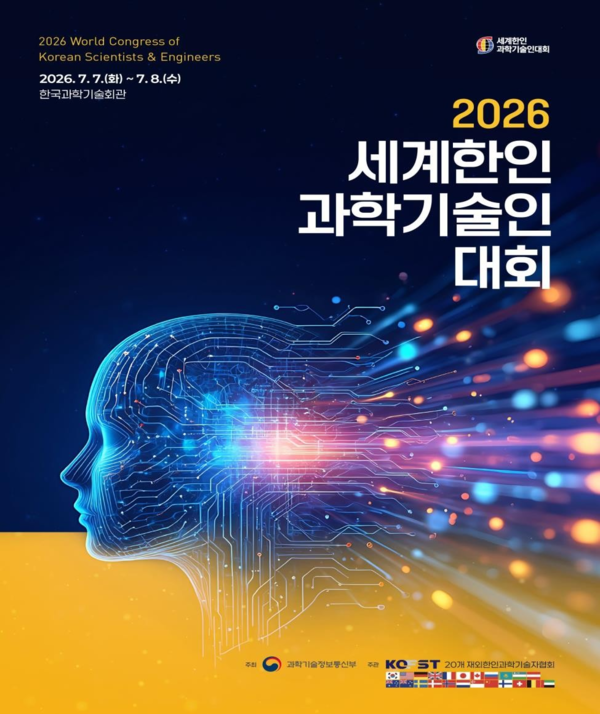
South Korea's Ministry of Science and ICT has prepared an event to promote exchanges among Korean scientists and engineers at home and abroad and to expand global cooperation.
The ministry held the 2026 World Korean Scientists and Engineers Conference on July 7 at the Korea Science and Technology Center in Seoul. The event is hosted by the Korea Federation of Science and Technology Societies and 20 overseas Korean scientists and engineers associations.
The conference, running through July 8, is held under the theme, "A new paradigm for science and technology cooperation in the global AI era." It is a venue to share directions for science and technology development driven by the AI transition and to discuss ways to expand exchanges among Korean scientists and engineers at home and abroad and broaden global cooperation networks.
Korean scientists and engineers from home and abroad, along with government officials, attended the opening ceremony. It was followed by opening remarks from Oh-nam Kwon (권오남), president of the federation, and congratulatory remarks from Hyuk-chae Koo (구혁채), first vice minister of the Ministry of Science and ICT. A commemorative performance then took place in which representatives of overseas Korean scientists and engineers associations took the stage holding boards symbolising their associations in each country.
On the first day, Mi-young Cha (차미영), director of the Max Planck Institute, delivered a keynote speech. Major science and technology policy announcements were also made, including the Moonshot Project by Dae-hyun Oh (오대현), director general for Future Strategic Technology Policy at the ministry. A talk concert held under the theme, "In the era of a major AI transition, the science and technology agenda seen by global scholars," discussed the impact of new technologies on research methods and cooperation structures.
On the afternoon of the same day, an awards ceremony for the 2026 Korea Top Scientist and Engineer Award was held with Deputy Prime Minister and Minister of Science and ICT Kyung-hoon Bae (배경훈) in attendance. This year's winner was Jinwoo Cheon (천진우), a distinguished professor at Yonsei University and a pioneer in nanomedicine. Cheon was recognised for contributing to advances in precision diagnosis and treatment technologies through research on nano-magnetogenetics.
On the second day, sessions will be held on topics including science and technology policy directions for sustainable growth and expanding international cooperation platforms. Discussions will also continue by field, including overseas talent, AI-based regional innovation and revitalising next-generation exchanges. Related events will also be held, including the World Korean Women Scientists and Engineers Forum and the general meeting of the World Korean Scientists and Engineers Joint Consultative Council.
Bae said the government would also actively support Korean scientists and engineers so they can grow into key players who lead global research cooperation and the circulation of talent as a reliable bridge connecting South Korea and countries around the world.
 Jin-ho Lee
jhlee26@d-today.co.kr
Jin-ho Lee
jhlee26@d-today.co.kr