
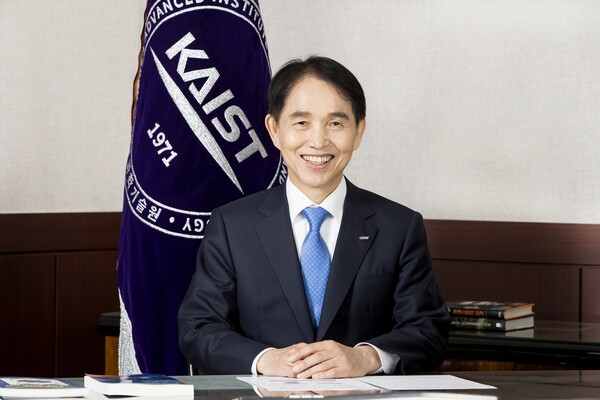
KAIST said on July 2 it will hold a farewell ceremony at John Hanner Hall on its main campus in Daejeon for its 17th president, Lee Kwang-hyung (이광형).
Attendees will include KAIST board members, deans and heads of offices, representatives of professors, students and staff, the university council, the professors' council, heads of affiliated institutes, and key local figures.
During his term, Lee stressed “a challenge unafraid of failure.” KAIST established the Failure Research Institute, the first such institute among South Korean universities, and expanded classes centred on questions and discussion.
In startups, he presented a “one lab, one startup” vision and pursued measures including longer leave-of-absence periods for student founders and simplified procedures for faculty startups. From 2021 to December 2025, KAIST produced 568 startup companies, of which 24 were listed. Cumulative enterprise value topped about 22 trillion won.
Education competitiveness also improved. Undergraduate applicants rose 87.5 percent to 10,661 in the 2026 academic year from 5,687 in the 2021 academic year. Over the same period, foreign graduate school applicants increased 144.5 percent to 2,205 from 902.
In research and education, KAIST established the country's first AI college and created the Graduate School of Engineering Biology, along with brain and cognitive science and the Division of Digital Humanities and Social Sciences. It also established the KAIST Art Museum and the AI Philosophy Research Center, expanding the foundation for convergence between science and technology and the humanities and arts.
It also strengthened its financial base. KAIST's total budget for 2026 is 1.61 trillion won, its largest ever, and pledged donations during Lee's term stood at 329.6 billion won as of June 25.
Global cooperation also intensified. KAIST expanded research cooperation with New York University in the United States, Merck in Germany, Formosa in Taiwan, and Khalifa University in the United Arab Emirates, and created new academic organisations in future strategic technologies, including semiconductor systems engineering, an AI semiconductor graduate school and a quantum graduate school.
Lee is set to say, “I hoped KAIST would go beyond existing frameworks, blaze a new path and become a university that moves toward bigger dreams.” He is also set to say, “I hope it continues to grow into a university that contributes to the future of humankind beyond the Republic of Korea.”
The ceremony will be livestreamed on KAIST's official YouTube channel.
Separately, the KAIST board held an extraordinary board meeting on June 29 and appointed Baechung-sik Bae (배충식), a mechanical engineering professor, as KAIST's 18th president. Bae is expected to be finalised as the 18th KAIST president after consent from the education minister and approval from the deputy prime minister who also serves as science and ICT minister.
 Jin-ho Lee
jhlee26@d-today.co.kr
Jin-ho Lee
jhlee26@d-today.co.kr