
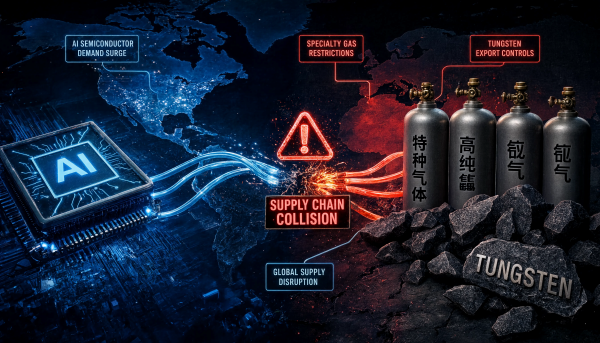
The drive to expand production of artificial intelligence (AI) semiconductors is shaking supply chains for specialty electronic gases. China’s export controls on high-purity tungsten have led to disruptions in Japan’s supply of tungsten hexafluoride (WF6), an analysis said. It said new supply-chain risks are growing for the production of high-bandwidth memory (HBM), DRAM and advanced logic chips.
Blockchain media outlet Cryptopolitan reported on June 27 that expanding investment in AI data centres and China’s restrictions on tungsten exports are combining to trigger an emergency in supply and demand for specialty electronic gases used in semiconductor etching and deposition processes. The bottleneck is drawing attention because it is emerging not in foundry capacity or back-end processes, but in key materials for semiconductor manufacturing.
China International Capital Corp (CICC) said in a recent report that expanding AI infrastructure investment and China’s restrictions on tungsten exports are simultaneously putting pressure on supplies of specialty electronic gases. It said production of advanced processors used in large language model (LLM) data centres, AI servers and cloud inference systems could be directly affected.
The spread of AI is sharply increasing not only semiconductor output but also gas usage per process. Nanda Optoelectronics said specialty electronic gases account for about 13 percent of wafer manufacturing materials, the second-largest share after silicon wafers.
Usage rises further as processes become more advanced. The report said a 65 nanometre (nm) process requires about 20 etching steps per wafer, but a 7 nm process, mainly used for AI accelerators, rises to about 140 steps. It means specialty gas consumption jumps as chips become more advanced.
Expanding HBM production is also lifting demand. Specialty gases including WF6 are essential for forming through-silicon vias (TSV) in HBM. Demand for related gases is also continuing to grow as the number of 3D NAND layers increases in AI-related non-volatile storage devices.
Investment indicators point to the same trend. TrendForce forecast 2026 global foundry market revenue would rise 24.8 percent from a year earlier to $218.8 billion. CICC also projected capital expenditure by the top eight cloud service companies would rise about 61 percent and shipments of AI servers would increase about 28 percent.
On the supply side, China’s tungsten export controls are a key variable. China introduced a licensing system in February last year for exports of major strategic minerals including tungsten. After that, Japan’s WF6 makers Kanto Denka Kogyo and Central Glass notified South Korean customers that inventories were nearly depleted and it would be difficult to guarantee stable supply until the second half of 2026, the report said. WF6 is a key material used to form tungsten wiring in advanced logic chips, DRAM, HBM and 3D NAND.
The problem is that alternative sources of supply are limited. Japanese companies account for about 24 percent of global WF6 output, but Western supply chains such as the United States are in no position to replace that in the short term. Critics also point to limits in diversifying supply chains because the United States has already halted tungsten mining.
Chinese companies are quickly exploiting the gap. CSIC Special Gas currently has annual WF6 production capacity of 2,000 tonnes and plans to add 1,000 tonnes by 2027 to expand to 3,000 tonnes in total. HaoHua, Zhongju Core and Heyuan Gas are also increasing capacity in succession as they move to expand market share.
Prices are also rising quickly. Data from China’s General Administration of Customs showed the average export price of WF6 from January to May this year exceeded 950,000 yuan per tonne. As of late June, 6N (99.9999 percent) grade products rose to 2 million to 2.5 million yuan per tonne, it said.
The strategic importance of the specialty electronic gas market is also growing. Market research firm Persistence Market Research estimated the global market would grow from about $5.1 billion in 2025 to $6.9 billion in 2032. It expected about 69 percent of total consumption would be concentrated in the Asia-Pacific region, including China, Taiwan and South Korea, because semiconductor production facilities are clustered in the region.
The market landscape is also changing. The global electronic gas market is currently dominated by four companies — Linde, Air Liquide, Air Products and Nippon Sanso — which together hold more than 70 percent. But the share of locally sourced electronic gases for integrated circuits (IC) in China has already risen to about 25 percent, and CICC forecast Chinese firms would expand their share further on the back of price competitiveness and production capacity.
The analysis said such changes could also act as a new supply-chain risk for HBM producers including Samsung Electronics and SK Hynix. With reliance on Japanese WF6 having been high, the report said there is a possibility that if supply constraints are prolonged, they could affect expansion schedules at major semiconductor production hubs, including South Korea.
Key variables going forward will be the pace of high-purity quality certification for Chinese-made WF6, the speed of verification for use in advanced processes, and how quickly tungsten supply chains can be diversified outside China. The report said securing specialty gases is also expected to emerge as a core competitive edge as competition in AI semiconductors intensifies.
 Jinju Hong
hongjj@d-today.co.kr
Jinju Hong
hongjj@d-today.co.kr