
Hanwha Q Cells is stepping up field demonstrations as it seeks to take an early lead in the next-generation high-efficiency solar cell market. Hanwha Solutions' Q Cells division (Hanwha Q Cells) said on Sunday it will participate as the lead institution in a government research and development project to develop and demonstrate tandem module technology combining perovskite and crystalline silicon.
The project is part of the Energy Technology Development Programme overseen by the Korea Institute of Energy Technology Evaluation and Planning under the Ministry of Climate, Energy and Environment. Hanwha Q Cells recently signed an R&D agreement titled "Technology development and demonstration of commercial-area perovskite/crystalline silicon tandem modules." The consortium includes 9 organisations, including South Korean companies, research institutes and universities, as joint research institutions.
The consortium will conduct research for 3 years starting in April this year. The goal is to demonstrate commercial-area tandem modules with module efficiency of at least 28 percent and an area of at least 1.7 square metres. Hanwha Q Cells will focus on developing tandem manufacturing technology designed for mass production, and will also conduct outdoor demonstrations and business feasibility analysis with South Korean research institutes. It aims to secure manufacturing technology with performance, reliability and economic viability in a timely manner.
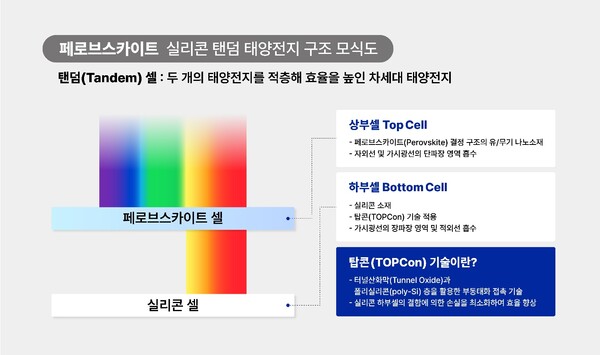
Tandem cells are a next-generation technology that can raise power generation efficiency compared with existing silicon cells by absorbing light by wavelength band. Their theoretical limit efficiency is 44 percent, about 1.5 times higher than silicon cells at 29 percent, the company said. If tandem technology stabilises, it is expected it could also be applied to the space solar power market.
Hanwha Q Cells said it will link tandem pilot lines it operates in South Korea and Germany with the government-backed project to build up demonstration data and gradually secure the technological foundation for a transition to mass production. It targets commercialisation in 2029.
Moon Soo-jin (문수진), head of Hanwha Q Cells' Pangyo R&D Center, said, "This project is an important turning point that will fully verify the commercialisation potential of tandem solar cells," adding, "We will bring forward the commercialisation timeline for tandem technology and also contribute to strengthening the global competitiveness of the domestic solar industry ecosystem."
 Seok Dae-geon
d2dg@d-today.co.kr
Seok Dae-geon
d2dg@d-today.co.kr