
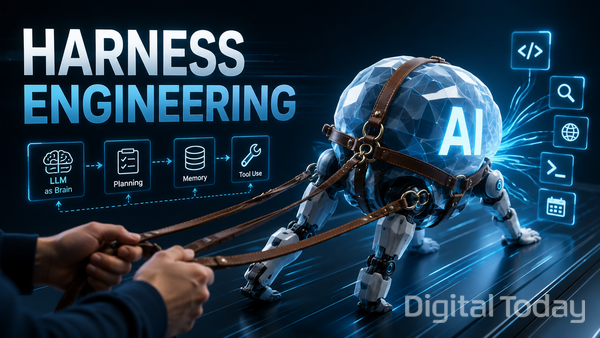
As artificial intelligence (AI) coding tools spread, developers are using the concept of "harness engineering". It is a name given to the skill of using AI "well", but the exact concept is not easy to grasp.
To clarify what harness engineering means, DigitalToday met An Su-bin (안수빈), a research engineer at Asteromorph. He defined it as "giving hands and feet to AI work". Asteromorph is developing an AI scientist model.
Harness engineering comes from the word "harness". The idea is to put a harness on AI and make it move as desired.
To understand it precisely, it is necessary to know the structure of AI work. AI work proceeds through four processes: brain (LLM as brain), planning, memory and tool use. It is a concept systematised by Lilian Weng (릴리안 웽), a former vice president of research at OpenAI, in her 2023 blog post "LLM Powered Autonomous Agents". In this framework, the developer acts as a "foreman" who tells the LLM what to do, how to do it and in what order.
Instructions are given through the LLM context window. Developers do not change the model training itself. They can set fixed rules with a system prompt or limit the search range with retrieval-augmented generation (RAG). They can also call LLM tools such as search, calculator, API, code runner and calendar, then feed the results back in. It is also possible to re-enter the output of other agents. Harness engineering encompasses all of this design work.
There is a broader concept called "context engineering". If harness engineering focuses more on setting up the AI work environment, context engineering designs all inputs delivered to the LLM.
As harness engineering know-how accumulates, it can be packaged in a reusable form. This package is called a "skill". It is work that "turns tacit knowledge in the developer world into explicit knowledge", An said, referring to items such as coding conventions, prompt structure and contextual information.
Skills spread quickly in developer communities through the platform "skills (skills.sh)", unveiled by Vercel in January. Before that, Anthropic released the skill format as an open standard in December 2025. More recently, a "skill creator" has emerged, meaning a skill for making skills. AI analyses existing work patterns or prompts and packages them for reuse on its own. AI coding tools such as Codex and Claude Code offer this as a plugin.
Recently, more developers have moved to focus on the model itself rather than skills. The aim is to produce better AI work results. The view is that skills ultimately depend on model performance. The direction of AI-use techniques has shifted from controlling LLM behaviour to combining models.
That has been the backdrop to the rise of the "multi-agent" concept. It is the idea of multiple agents with different roles collaborating. There are various approaches. Anthropic's official pattern is "Orchestrator-Workers". A leader agent receives a task and assigns it to subordinate agents, and when given a goal, the AI itself determines an appropriate workflow pattern. Other patterns include prompt chaining, routing, parallelisation and evaluate-optimise.
Some developers also predict that the era of harnessing will fade and the era of the "Ralph Wiggum Loop" will arrive. It is a technique devised in July 2025 by developer Geoffrey Huntley (제프리 헌틀리), and is named after the character Ralph Wiggum from the animated series "The Simpsons". Like the character's trait of not being smart but never giving up, it is a methodology that repeats the same task without complex design until a stopping condition is met to produce the desired result.
 Seulgi Son
sageson@d-today.co.kr
Seulgi Son
sageson@d-today.co.kr