
[Digital Today reporter Dae-geon Seok (석대건)] Hardware supply chains are emerging as a battleground for next-generation industries. As vehicles become more intelligent and electrified, humanoid robots move into mass production and power density at AI data centres surges, electronic components spanning power semiconductors, sensors, connectors and materials have become a shared bottleneck and a competitive market. As it becomes harder to deliver stable performance under constraints on power, space and cost, hardware completion that fully realises finished products’ functions is increasingly translating directly into competitiveness.
The auto sector shows this trend most clearly. According to Chinese industry research firm EO Intelligence, adoption of AI-based intelligent electric vehicles in China was close to 20 percent in 2025 and is expected to exceed 50 percent in 2030. Chinese automakers sold about 27 million vehicles worldwide last year, topping Japan for the first time.
Competition in intelligent driving is also shifting from securing computing power to design capabilities that deliver stable performance with limited power. As smart cockpits and intelligent driving become standard across companies, the battleground is moving from software to hardware completion.
Charging standards have also shifted from driving range to speed and efficiency. BYD said megawatt-class charging can enable more than 400 km of driving with a 5-minute charge, and CATL signalled a pilot test of all-solid-state batteries in 2026 followed by limited production in 2027. As voltage platforms rise from 800V to more than 1,000V, high-voltage safety and thermal management have become common challenges, while soaring data traffic is increasing the importance of high-speed, high-voltage automotive connectors. Power semiconductors, sensors and connectors once seen as auxiliary parts are being assessed as the first gateway in competition over vehicle electronics.
Such supply chain bottlenecks are also appearing in humanoid robots. Unitree and Zhiyuan Robot have entered mass production stages, but making one unit and making tens of thousands uniformly are cited as different issues. As computing is distributed by joint units for real-time control of more than 40 joints, demand is rising for high-performance MCUs, while silicon carbide (SiC) power semiconductors to control heat in narrow joints and the reliability of connectors that withstand shock and vibration are seen as variables that determine mass production success.
The same is true for data centres. As single-rack power density exceeds 100 kW, the shift to immersion and water cooling is accelerating, and supply shortages are emerging even for high-spec connectors such as 224G high-speed copper interconnects. As autos, humanoids and data centres all head toward the same conditions of high voltage, high speed and high density, analysis suggests connectors are evolving from simple parts to system-level engineering. This area spanning power semiconductors, sensors, connectors, materials and thermal management overlaps with where South Korea’s electronic components industry has built competitiveness over a long period.
◆ 'Electronica Shanghai' where global powerhouses and emerging Chinese firms clash
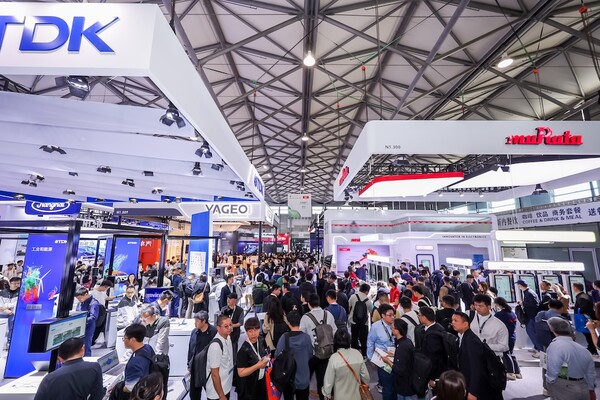
A stage to gauge how this competitive structure is taking shape will be Asia’s largest electronic components exhibition, Electronica Shanghai 2026, set to open in Shanghai on July 1. The exhibition runs from July 1 to 3 at the Shanghai New International Expo Centre (SNIEC). Organisers said more than 2,032 companies will participate this year. The exhibition area is about 120,000 square metres, with visitors expected to exceed 70,000.
The venue will bring together global vehicle electronics and components leaders such as Texas Instruments, TE Connectivity and Rosenberger, alongside emerging Chinese semiconductor companies such as Yuenn and Novosense, to compete in capabilities in power, connectivity and thermal management solutions. Fourteen forums and side events are planned covering physical AI and data centres, new energy vehicles (NEV), autonomous driving, energy storage systems (ESS), third-generation power semiconductors and connectors. A Physical AI theme hall targeting humanoids will also be operated. With U.S. restrictions on advanced semiconductors to China reaching an extreme, China is filling gaps by internalising legacy semiconductors and ecosystems for vehicle electronics components.
South Korean companies will also be represented. Component makers including Poongsan, Cochip, Samwha, Daejoo Electronic Materials and Yura will participate, along with semiconductor companies such as MangoBoost, PowerCubeSemi, Boss Semiconductor, HyperAccel and Pixelplus. In particular, domestic fabless and design house firms including Boss Semiconductor, HyperAccel, Aimfuture and AD Technology will gather in the Korea Pavilion to showcase AI acceleration and automotive semiconductor design capabilities to global buyers. MangoBoost and PowerCubeSemi will also participate through the Korea Pavilion operated by the Korea Semiconductor Industry Association, which will introduce domestic companies’ technical capabilities on site.
As finished products move beyond a phase of adding AI to a phase of stably supporting AI, the question is what position South Korean parts and fabless firms can secure in the premium segment amid low-price offensives by local Chinese companies. The industry is watching whether business channels will open beyond simple visits to win a place in next-generation supply chains. An industry official said, "Electronica Shanghai 2026 is an opportunity for South Korean vehicle electronics, semiconductor and electronic components companies and institutions to directly read the site where the next landscape of the global supply chain is being drawn."
 Dae-geon Seok
d2dg@d-today.co.kr
Dae-geon Seok
d2dg@d-today.co.kr