
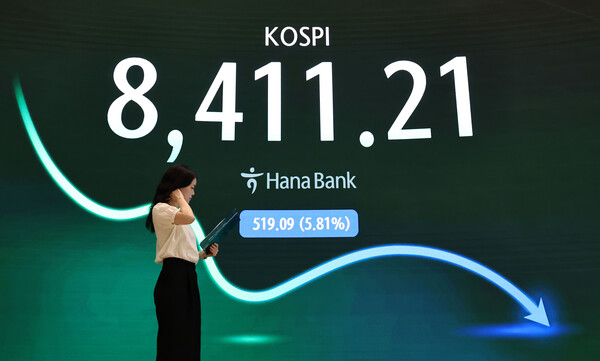
[DigitalToday reporter Sangyeop Oh (오상엽)] South Korea’s KOSPI fell more than 5 percent to end trading around the 8,410 level. The benchmark slid more than 8 percent intraday, triggering a first-stage circuit breaker, but trimmed some of its losses in the afternoon.
On June 26, the KOSPI closed down 519.09 points, or 5.81 percent, at 8,411.21. It opened down 117.12 points, or 1.31 percent, at 8,813.18 but slid as low as the 8,100 level during the session. It later recovered the 8,400 level as bargain hunting emerged.
In the main board market, individuals net bought 81.873 trillion won. Foreigners and institutions net sold 46.265 trillion won and 37.845 trillion won, respectively.
The KOSPI’s plunge led to the activation of a sell-side sidecar in the morning, followed by a first-stage circuit breaker at 12:10 p.m. Trade across the market was halted for 20 minutes after the KOSPI stayed down more than 8 percent from the previous close for 1 minute.
Most top market-cap shares fell. Samsung Electronics closed down 19,000 won, or 5.30 percent, at 339,500 won. SK Hynix fell 244,000 won, or 8.36 percent, to 2,673,000 won.
SK Square fell 9.43 percent, Hyundai Motor dropped 4.47 percent, Samsung Life slid 3.24 percent, Samsung C&T fell 4.72 percent, LG Energy Solution lost 5.82 percent and Samsung Biologics slipped 3.10 percent. Samsung Electro-Mechanics fell 0.20 percent, limiting its losses compared with others.
The KOSDAQ also stayed weak. It closed down 36.44 points, or 4.10 percent, at 851.37.
The won-dollar exchange rate fell. At the close, it was 1,537.90 won per dollar, down 7.10 won, or 0.46 percent, from the previous session.
Hwang Soo-wook (황수욱), a researcher at Meritz Securities, analyzed the sharp fall as “more of a short-term position adjustment than a structural departure.”
Han Ji-young (한지영), a researcher at Kiwoom Securities, said the move reflected “concerns about declining memory demand, short-term profit-taking after the KOSPI’s sharp rebound over the past 2 trading days, and the recurrence of side effects from crowding.” She added that “rumors of a delay in OpenAI’s listing and renewed uncertainty around the Strait of Hormuz have a limited impact on the sharp decline.”
 Sangyeop Oh
yub@d-today.co.kr
Sangyeop Oh
yub@d-today.co.kr