
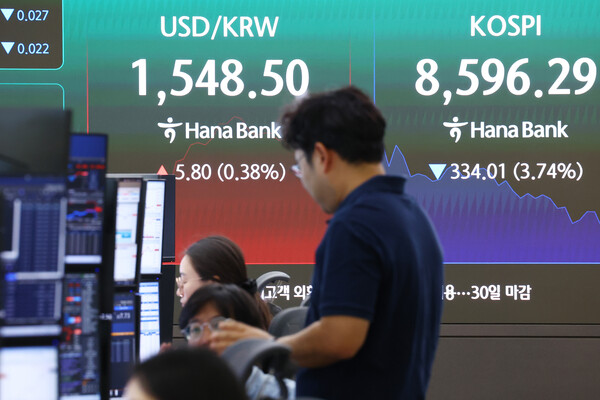
South Korea's KOSPI slid more than 8 percent, triggering a Level 1 circuit breaker on the main KOSPI market. Heavy selling, led by large semiconductor stocks, prompted a temporary halt in trading across the market following a sell-sidecar measure.
The Korea Exchange said a Level 1 circuit breaker was triggered at 12:10 p.m. on Friday. It was the fifth activation this year and the 11th on record.
At the time of the trigger, the KOSPI fell 731.97 points to 8,198.33 from the previous session's close of 8,930.30. The decline rate was 8.19 percent. The conditions for a Level 1 circuit breaker were met after the index stayed down more than 8 percent from the previous trading day's close for 1 minute.
Trading in all stocks listed on the main KOSPI market was halted for 20 minutes, excluding bonds. After the halt, orders are accepted for 10 minutes for single-price trading, and then continuous trading resumes. Trading in stock products linked to the main KOSPI market was also suspended.
The KOSPI extended losses from early in the session. As of 11:18 a.m., the index was down 483.76 points, or 5.42 percent, at 8,446.54 from the previous session. Selling then intensified further, even threatening the 8,200 level.
Earlier, the main KOSPI market also triggered a sell-sidecar measure that temporarily suspends the effectiveness of program sell orders. It was the 14th sell-sidecar activation on the main KOSPI market this year. Market stabilisation measures kicked in again as investor sentiment cooled sharply just 1 day after a sharp rally the previous day.
The exchange triggers a Level 2 circuit breaker if, after a Level 1 activation, the KOSPI falls at least 15 percent from the previous session's close and an additional 1 percent or more from the Level 1 trigger level for 1 minute.
After a Level 2 activation, if the index falls at least 20 percent from the previous session's close and an additional 1 percent or more from the Level 2 trigger level, a Level 3 circuit breaker is triggered and trading ends for the day.
The market is citing the stability of supply and demand for large semiconductor stocks, the intensity of foreign selling and the direction of the exchange rate as key variables that will determine the index's next direction.
 Sangyeop Oh
yub@d-today.co.kr
Sangyeop Oh
yub@d-today.co.kr