
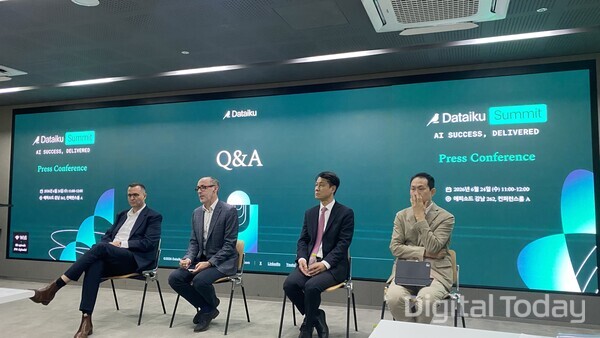
[Digital Today reporter Seulgi Son] Enterprise artificial intelligence (AI) platform company Dataiku on Tuesday held a media briefing at Episode Gangnam 262 in Seocho-gu, Seoul, and unveiled its AI project auto-generation tool Cobuild.
Cobuild automatically creates an entire AI project package without coding, including data pipelines, machine-learning (ML) models, agents and applications, when business users enter business goals in natural language. It also supports connections to external large language models (LLMs) such as OpenAI and Anthropic. The output is provided as a Visual Flow, allowing non-technical users to review, edit and approve it.
Andrew Boyd (앤드류 보이드), Dataiku executive vice president for Asia Pacific and Japan (APJ), cited McKinsey research, saying more than 88 percent of companies use AI but only 6 percent experience real value in terms of return on investment (ROI). He said too many cases stop at pilots and are not deployed into operating environments.
Jean-Guillaume Appert (장기욤 아페르), director of product management, explained that Dataiku adopted a structure that first defines the business case at the start of agent development and continuously monitors ROI metrics on a dashboard in the governance module.
Appert cited embedded governance as a differentiator from competing products. He said that as Claude Code and Codex emerged early this year, LLMs have become better at generating code, but such code cannot reflect compliance and governance and sustainability decline over time. He said Cobuild combines a natural language-based user experience with visibility and governance through flows.
Boyd highlighted that non-technical users can also validate the work process. He said other platforms can output thousands of lines of code for the same question, leaving business users unable to tell whether it was properly built or accessing appropriate data. He said Dataiku lets users visually confirm and verify data flows through Visual Flow even with the same prompt.
Jongdeok Kim (김종덕), head of Dataiku Korea, said domestic companies are also under pressure to adopt agents. He said large South Korean companies are already issuing instructions at the CEO and CIO level to build several agents per department and called it a matter of survival rather than a simple trend. He added that if many are built quickly, a situation will emerge where maintenance is not possible and governance is absent, and stressed the need to build a platform-based foundation.
Dataiku also introduced new products including Expert to Agent (E2A), Agent Management and Reasoning System. E2A is a technology that converts in-house business experts' knowledge into an AI agent's reasoning logic. Agent Management integrates and manages many distributed AI agents on a single screen. It is scheduled to be released within the year.
 Seulgi Son
sageson@d-today.co.kr
Seulgi Son
sageson@d-today.co.kr