
Tesla is pushing to enter the modular artificial intelligence (AI) data centre hardware business.
On June 21 local time, electric vehicle outlet Electrek reported that Tesla filed a trademark application for “Megapod” with the U.S. Patent and Trademark Office this month.
The filing is a trademark application based on an intent to use. The product has not been released yet, but the intended use described in the application is relatively specific. Megapod is listed as a modular data centre hardware system for AI computing, including computer servers and hardware for AI data processing, networking equipment, power distribution devices and cooling systems.
Tesla also included a self-contained modular computing hardware system for AI workloads. It bundles computing devices, power distribution and cooling facilities within a single unit, along with downloadable software to monitor, manage and optimise it. Rather than selling individual chips or batteries, the idea is closer to supplying a packaged, server-room-scale integrated facility needed for AI training and inference.
The key issue is the market environment. Nvidia is effectively setting the benchmark product in this field. Nvidia’s GB200 NVL72 is a rack-scale system combining 72 Blackwell graphics processing units (GPUs) and 36 Grace central processing units (CPUs), and the DGX SuperPOD expands that into a cluster with thousands of GPUs. Dell and Supermicro also supply products based on the same platform. Even if Megapod is released, it would have to compete with them from the outset.
The trademark name itself is not entirely new. Submer, a company specialising in immersion cooling, already sells a box-type data centre product called Megapod and holds a related trademark. Tesla’s filing classification, however, is for computer hardware.
Tesla’s weakness is its limited foundation in the compute hardware business. Tesla’s AI training cluster “Cortex,” which it operates at its Texas Gigafactory, uses about 67,000 Nvidia H100-class GPUs. To Nvidia, Tesla is closer to a large customer than a competitor.
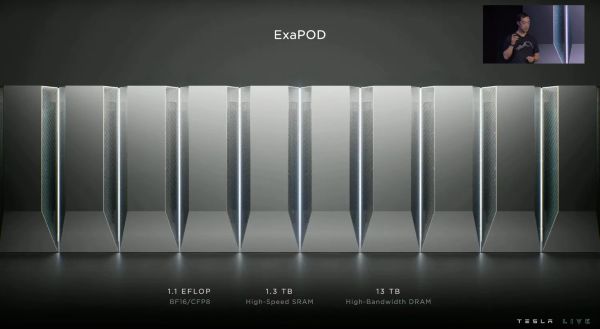
Its track record in developing its own AI hardware has not been smooth. Tesla halted the Dojo supercomputer project in August 2025. Elon Musk at the time described the Dojo 2 design as “a dead end of evolution.” Tesla then shifted direction to AI5 and AI6 chips, but AI5’s tape-out was delayed by almost 2 years. AI6 was also pushed back by about 6 months due to production setbacks at Samsung Electronics’ 2-nanometre process, delaying mass production to the end of 2027.
In this situation, the area where Megapod could have real meaning is power and thermal management. Tesla sells its Megapack and new Megablock energy storage devices as power buffers for AI data centres. xAI, led by Musk, was also reported to have purchased Megapacks worth about $1 billion to secure power for AI training.
This has focused attention on the possibility that Megapod could put more weight on an infrastructure package such as power electronics, thermal management and an enclosure, rather than Tesla’s server design competitiveness.
 Yoo Seung-a (유승아)
ysah@d-today.co.kr
Yoo Seung-a (유승아)
ysah@d-today.co.kr