
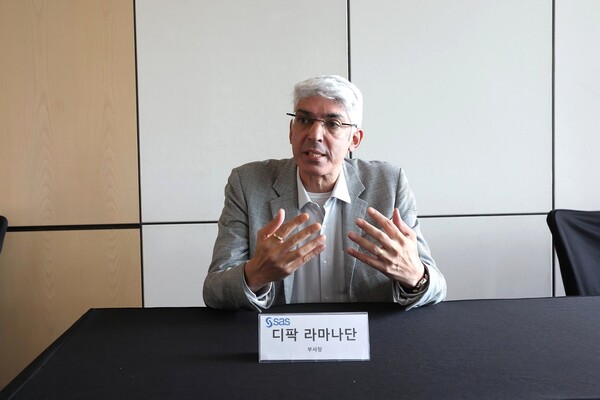
[DigitalToday reporter Chi-gyu Hwang] "We will provide data-utilisation solutions that support decision-making, based on industry domain experience built up over 50 years."
Competition among major software companies is intensifying over AI platforms that help companies analyse enterprise data. SAS is highlighting industry-specific solution experience and governance capabilities as its differentiators.
Deepak Ramanathan (디팍 라마나단), vice president and head of customer advisory for SAS Asia-Pacific, recently held a media roundtable at SAS Innovate on Tour 2026 in Seoul. He summarised the company's data and AI competitiveness in these terms.
He said SAS has built analytics solutions since its founding in 1976, focusing on heavily regulated industries such as banking, manufacturing, the public sector, healthcare and life sciences. It started with clinical analytics and expanded into banking, government, healthcare, life sciences and manufacturing.
Ramanathan said, "We are not selling a platform, but providing applications that solve problems in each industry." He cited examples including credit and decisioning solutions for a bank chief risk officer, anti-money laundering solutions and supply chain intelligence solutions.
Mark Demers (마크 드머스), managing director and head of global industry and solution marketing, said, "Many companies say they can analyse enterprise data, but for SAS the key differentiators are decisioning and industry-domain specialised solutions." He emphasised, "Field experience is embedded in SAS DNA, and listening closely to the solutions customers need is SAS's 50-year history." He also highlighted that "SAS has a large number of staff with field backgrounds in banking, the public sector and manufacturing."
The company also introduced Data Maker, a synthetic data solution, as part of efforts to strengthen its industry-specific capabilities.
Ramanathan said, "Data Maker can be used for life sciences companies to generate synthetic data and also in areas such as financial fraud and digital identity fraud detection." He added, "SAS is not implementing AI technology simply from a platform perspective, but applying it in a way that resolves the specific business problems customers face."
Governance is another keyword SAS is emphasising. SAS AI Navigator, the enterprise AI governance platform offered by SAS, helps organisations see and control at a glance various AI assets and use cases, including large language models, AI agents, open-source models and SAS's own AI models.
Ramanathan said, "We provide governance and an agent framework not only for SAS models but also for open-source models used by customers and large language models overall." He added, "The first things companies need to put in place when it comes to adopting AI are data management and AI governance."
SAS upgraded Viya, its cloud-based end-to-end data and AI platform.
The focus was on expanding integration with major external data platforms. This will allow Viya users to bring SAS analytics capabilities directly into the data platforms they already use, the company said.
Viya also focuses on industry specialisation. Ramanathan said, "Based on the Viya platform, we provide industry-specific applications in pre-packaged end-to-end form." He added that they are designed for specific roles and functions. "In banking, we provide credit and decisioning solutions for a chief risk officer, anti-money laundering solutions for a chief crime officer, and customer intelligence solutions for a head of marketing," he said.
SAS Viya Copilot is an interactive AI assistant built into the SAS Viya platform that helps experts use AI within analytics workflows. Viya Copilot uses a model trained by SAS and is provided on Microsoft Azure. Demers said the company is considering an on-premises delivery model as well as offering it through other cloud services. He said South Korean financial companies are watching which cloud to use as network separation regulations have been eased in the financial sector. He added that SAS is also preparing cooperation with South Korean cloud companies to target the country's public sector market.
 Chi-gyu Hwang
delight@d-today.co.kr
Chi-gyu Hwang
delight@d-today.co.kr