
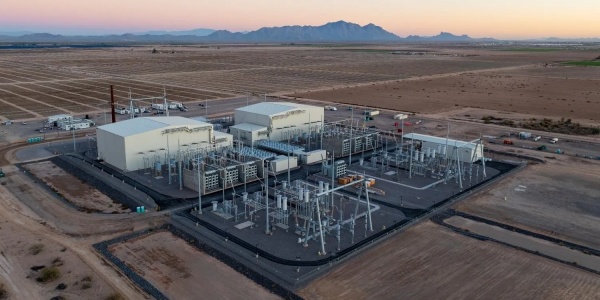
A major transmission infrastructure project, SunZia, connecting the U.S. Southwest has started operating.
On June 19 local time, electric vehicle outlet Electrek reported that Pattern Energy and Hitachi Energy said the SunZia transmission line has entered full operation, sending renewable power from New Mexico to Arizona and western grid demand centers.
SunZia is a combined wind and transmission project with a total cost of $11 billion. Its transmission line is a 550-mile ultra-high-voltage direct current line. It can move up to 3,000 MW of electricity produced at the SunZia wind complex in New Mexico. The supply is enough for about 1 million U.S. households.
The start-up comes alongside grid bottlenecks that cannot be resolved by expanding generation facilities alone. In the United States, electricity demand is rising due to data centre expansion, increased electrification and industrial growth. SunZia directly links generation sites and demand centres, with a structure that relatively lowers losses in long-distance transmission. It means a foundation has been set to deliver large-scale wind power to actual consumers.
The wind farm itself is also large. The SunZia wind complex is 3.65 GW in size and was built with 916 turbines. Still, the core of the project lies in the transmission network that can move generated electricity to regions that need it on time. Pattern Energy and Hitachi Energy said the SunZia line is now fully operational and can carry renewable power to customers across the Southwest.
It is also a record-scale project technically. SunZia applies a plus-minus 525 kilovolt ultra-high-voltage direct current system. The two companies said it is the largest installation in the United States among voltage-source converter-based ultra-high-voltage direct current cases and is also among the top levels globally.
From the perspective of grid operation, it is highlighted that it could help respond to the so-called Duck Curve, when solar generation drops sharply in the evening. Ultra-high-voltage direct current systems can rapidly adjust power flows, allowing more wind power to be supplied when solar output falls. This can also be used to reduce reliance on fossil-fuel power plants.
It is also expected to play a role in improving stability when grid conditions are disrupted by weather changes and other factors. The SunZia system was designed to support grid stability under changing conditions, including weather-related disturbances.
The carbon-reduction effect is also large. The SunZia project is expected to cut about 9 million tonnes of carbon dioxide emissions in its first full year of operation. The two companies said this is comparable to removing about 3 million gasoline vehicles from roads for one year.
The start-up again shows that the United States needs to expand transmission networks alongside growth in renewable generation. Building large wind farms alone does not complete power supply, and long-distance transmission infrastructure linking to demand centres must support it to respond to rising power demand and grid stability issues. In this trend, SunZia has become an example that increases practical renewable supply capability in the western U.S. power grid.
 Jinju Hong
hongjj@d-today.co.kr
Jinju Hong
hongjj@d-today.co.kr