
Battery applications are expanding beyond electric vehicles (EVs) and energy storage systems (ESS) to the level of server racks. As power density per rack in artificial intelligence (AI) data centres surges, facility-level uninterruptible power supplies (UPS) alone are finding it difficult to handle momentary power fluctuations. Battery backup units (BBU) that discharge briefly and strongly near servers are emerging as a new source of demand for the battery industry.
BBU is a concept defined within open standards for data centres led by big tech. Under the Open Rack V3 (ORV3) standard of the Open Compute Project (OCP), in which Meta participates, an open rack power architecture consists of a centralised power shelf and a BBU shelf. The BBU shelf carries 6 modules in a 5+1 redundancy configuration and is designed to supply backup power for a certain period when an alternating current (AC) outage occurs.
Behind this is a move to higher voltage. Under the existing ORV2, backplane voltage was 12V and system power was around 3 kW. As power demand rose, the burden of current, copper wiring and heat increased. Raising backplane voltage to 48V became the basis of the ORV3 standard. The aim is to reduce wiring load and heat by delivering the same power at lower current.
In this shift, BBUs are used to distribute backup power from the facility level to the rack level. According to materials from Schneider Electric's Data Center Science Center, integrating power supply units (PSU) and placing BBUs at the rack level makes it possible to remove the UPS at the top. A problem in a specific BBU affects only a single rack, while a centralised UPS can affect many devices. It says a distributed architecture improves facility reliability.
The fundamental driver of demand is the sharp rise in power density of AI racks. Comments from Nvidia cited by Data Center Dynamics (DCD) show Hopper-generation GPU racks consumed about 40 kW, while the Blackwell generation rose to about 120 kW. The VR200 NVL72 rack, which is to enter mass production in the second half of 2026, is expected at about 190 to 230 kW, and the Rubin Ultra NVL576 rack in the second half of 2027 is expected to reach 600 kW. As load swings widen, the need for distributed batteries that respond close to the rack also grows.
When thousands of graphics processing units (GPU) perform the same computation at once, the entire data centre power load can surge, and that shock can unsettle the stability of upstream transmission networks. Analysis has emerged that the role of UPS is also expanding from traditional emergency backup to active power smoothing. Under this structure, BBUs handle millisecond-level rack and chip responses by absorbing sharp load swings on the GPU side and converting them into a flatter load for the upstream power grid.
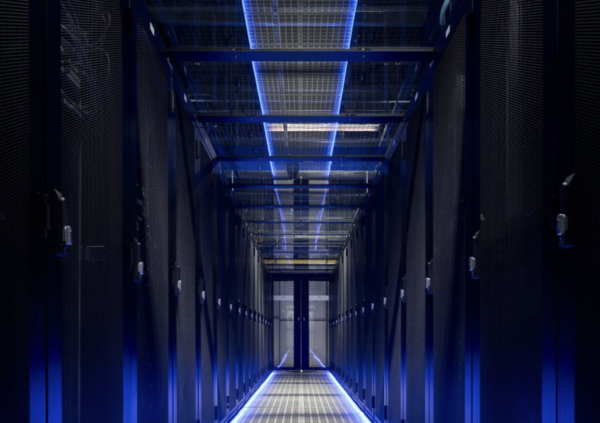
AI data centre rack power density surge lifts demand for backup power units.
Market forecasts are also pointing higher. Samsung SDI said on its first-quarter conference call that the global BBU market is expected at $800 million this year, growing more than 70 percent from a year earlier. It said forecasts are being raised as cloud service providers (CSP) move to secure supplies directly.
The beneficiaries are centred on the cell and components supply chain. Samsung SDI unveiled a next-generation BBU battery based on the 21700 form factor with output increased from 120W to 200W at InterBattery 2026, and will begin production in June. LG Energy Solution plans to start mass production in the second half of a tabless 2170 cylindrical battery for BBUs, alongside expanding supply of LFP-based ESS. Hyundai Motor Securities analysed that most BBU demand for North America will be met by Panasonic, Samsung SDI and LG Energy Solution.
Another point to watch is the extent of next-generation power architecture changes. Meta's next-generation rack uses plus or minus 400V high-voltage direct current (HVDC) to raise capacity up to 800 kW. Nvidia and its partners are developing an 800VDC power architecture for 1 megawatt-class racks in line with the 2027 timing of Rubin Ultra. An industry official said, "A cell's capabilities to handle high output and high voltage will be a competitive factor in the BBU market going forward."
 Daegeon Seok
d2dg@d-today.co.kr
Daegeon Seok
d2dg@d-today.co.kr