
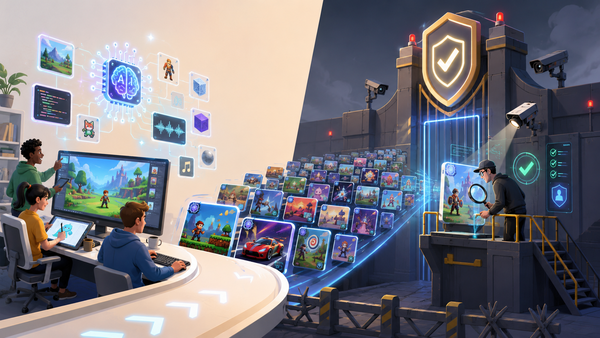
[Digital Today reporter Ho-jeong Lee] As AI penetrates the entire game development process, the barrier to production is falling. But user backlash has followed whenever AI use becomes known, prompting analysis that a new hurdle has emerged around disclosure, review and trust.
IT media outlet Engadget recently cited Eurogamer as reporting that, based on SteamDB tallies, 1,704 of 8,700 titles participating in Steam Next Fest carried a generative AI use tag. That equals 19.5 percent, meaning 1 in 5 used AI.
In particular, given Steam Next Fest is an event that releases demos of upcoming games, it is interpreted as meaning AI use has already spread widely among new titles in the pre-release stage. SteamDB data showed the number of released titles on Steam that marked the use of AI content rose more than twofold to 4,710 in 2025 from 2,185 in 2024, and this year it surpassed about 3,200 as of June 3.
◆AI lowers development hurdles...large Korean companies adopt it companywide
Rising development costs and longer production timelines are behind the rapid increase in AI use. As processes such as graphics, translation, scenario writing, QA and live operations become more complex, demand has grown to cut repetitive work and produce early outputs quickly. Incentives are greater for indie and small developers, which must build prototypes and content with limited staff.
South Korea's game industry is on the same track. According to the "Content Industry Trends Analysis Report for Fourth Quarter and Full Year 2025" published in April by the Korea Creative Content Agency, the share of domestic game companies using generative AI was 70 percent, far above the content industry average of 32.1 percent. Of the game companies that adopted AI, 49.6 percent used it at the companywide level, and the most common area was content creation, at 67.2 percent.
Large companies are also embracing AI as a tool to improve work efficiency. Nexon has provided all employees with accounts for Anthropic's LLM, Claude, and built its own AI infrastructure, "Monolake". Netmarble is applying AI agents to all employees for code writing, internal knowledge search and QA automation. Krafton is operating its internal AI system, "KRIS", and on the 17th unveiled a beta service for a new Battlegrounds mode, "Ally Duo", that applies AI companion characters. It is a case of AI expanding beyond internal work assistance into content that directly meets users.
But a lower barrier to development does not mean the barrier to commercial success also falls. AI can quickly produce drafts of images, text and code, but it cannot judge a game's fun, completeness or user reactions. Nexon said at NDC 26 (Nexon Developers Conference) that AI was efficient in drafting world settings and designing quests, but had clear limits in areas requiring creative judgment, such as humor and emotional arcs. Nexon Korea co-CEO Dae-hyun Kang (강대현) said, "AI is raising development efficiency, but since the same tools are given to everyone, execution capability itself is unlikely to remain a decisive differentiator."
◆When AI is revealed, a trust hurdle awaits
As AI use grows, user trust is becoming more important. Valve revised its Steam AI rules in 2024 to allow generative AI use, while requiring developers to disclose such use. But tool-like use to improve development efficiency is excluded from disclosure requirements. That means the actual scope of AI use may be wider than Steam tag tallies suggest.
The problem is that the boundary between development support and final content is not always clear. Pearl Abyss' "Crimson Desert" faced allegations that, after its release this year, some AI assets made for testing in the early development stage were not filtered out during review and were included in the final build. Pearl Abyss moved to contain the issue by apologising and fully replacing the related resources, and the controversy did not become prolonged.
Embark Studios, a Nexon subsidiary, developed "ARC Raiders". After it became known that it used TTS (text-to-speech) technology for voice production, concerns were raised about the possibility of replacing voice actor labour, and it was later reported that some AI voice lines were replaced with recordings by actual actors. The two cases share the common point that backlash against AI use itself overlapped with user trust issues stemming from insufficient disclosure of the scope of use.
In South Korea, discussion of an AI labelling system is also gaining momentum. The government plans to specify standards for labelling generative AI content through a revision to the enforcement decree of the AI basic law, and is set to announce it in July. In the industry, opinions are emerging that disclosure standards are needed that distinguish between AI used for simple work assistance and AI included in content that users directly encounter.
Concerns about job insecurity are also present. A survey released by the IT committee of the Korean Confederation of Trade Unions' Chemical, Fibers, Food and Service Workers' Union showed that 77.3 percent of 1,078 employees at eight domestic game companies said they felt job insecurity due to the introduction of AI.
An industry official said, "It is difficult to go in a direction of not using AI, but putting AI outputs straight into a game and using it as an internal productivity tool must be distinguished." The official added, "Going forward, what will matter will be not whether AI is used, but how transparently the scope of use and review process are explained."
The hurdle to making games with AI has fallen. But the hurdle to making users trust those games is rising instead. Implementation tools have already been given to everyone. The remaining competition is expected to be decided by the ability to review AI outputs, explain them transparently to users and build that trust.
 Ho-jeong Lee
lhj@d-today.co.kr
Ho-jeong Lee
lhj@d-today.co.kr