
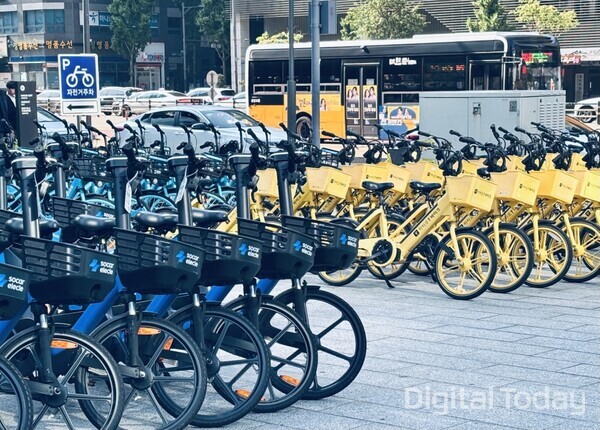
A planned merger and acquisition that had drawn attention over whether a clear No. 1 operator would emerge in South Korea's shared electric bicycle market has fallen through. Socar has recently scrapped the sale of its electric bicycle business unit, Elecle, which it had pursued since the second half of last year. Kakao Mobility, which operates T Bike, was the company that went as far as final negotiations. Had the deal been completed, a monopoly micro-mobility operator could have emerged based on cumulative subscribers and travel distance.
As of June 19, industry sources said Socar had been exploring a sale of the Elecle unit due to cost burdens. Elecle operates about 40,000 electric bicycles across 45 cities nationwide, but offline operating costs such as equipment upkeep, management and repositioning, and battery replacements have continued to weigh on profitability. Unlike car sharing, the shared electric bicycle business is structurally more dependent on manpower. The sale process dragged on for months because it failed to secure a suitable buyer.
In the sale process, Socar held acquisition talks with multiple companies, and Kakao Mobility is understood to have been the closest to closing a deal. Kakao Mobility operates T Bike, a shared electric bicycle business like Elecle.
If the deal had been completed, Kakao Mobility could have held a market monopoly in shared electric bicycles as well as taxi hailing. According to Socar, Socar Elecle recorded 2.2 million cumulative subscribers in five years, cumulative travel distance of about 60 million km and cumulative usage time of 3.6 million hours. Kakao Mobility's T Bike logged a cumulative travel distance of 140.85 million km from the start of service in February 2019 through this year. Simply adding the two would have produced 200 million km in cumulative travel distance and a subscriber base exceeding several million, implying that an overwhelming No. 1 operator could have emerged.
The reason the sale fell through was not conveyed in detail. A combination of factors, including technology, is reported to have played a role. As the effort to sell Elecle was delayed, the operational front also fell into a state of stagnation. With new investment and maintenance work put on hold on the premise of a sale, many bicycles were left in a management blind spot. Industry officials said user complaints did not 크게 surface, as the period coincided with the winter off-season. Some bicycles are understood to have been retrieved and are undergoing maintenance.
With the sale scrapped, Socar has settled on a direction of keeping the Elecle business while reducing its operating scale. It is proceeding with steps to retrieve devices that had been left unattended, repair them and redeploy them after reorganising its maintenance and management system. The company plans to improve operating efficiency and then adjust the number of bicycles step by step depending on market conditions. The move is seen as reflecting a judgment that slimming down the micro-mobility business, which has been slow to restore profitability, is unavoidable in order to focus resources on its core car-sharing business and its new autonomous driving venture.
Socar is currently restructuring its business around autonomous driving. It is working to establish an independent corporation dedicated to autonomous driving services during May. An investment of 150 billion won will be made in the new corporation. Socar CEO Jae-wook Park (박재욱) will also serve as CEO of the new corporation, with plans to pursue step-by-step commercialisation from L2-level car sharing to L4 fully autonomous ride hailing.
 Dae-geon Seok
d2dg@d-today.co.kr
Dae-geon Seok
d2dg@d-today.co.kr