
South Korea's financial authorities are pushing inclusive finance as a structural reform task across the financial system rather than a one-off measure to support livelihoods. They plan to take a comprehensive look that goes beyond expanding the supply of policy-backed finance for ordinary people, covering credit scoring, incentives for financial companies and the debt adjustment system.
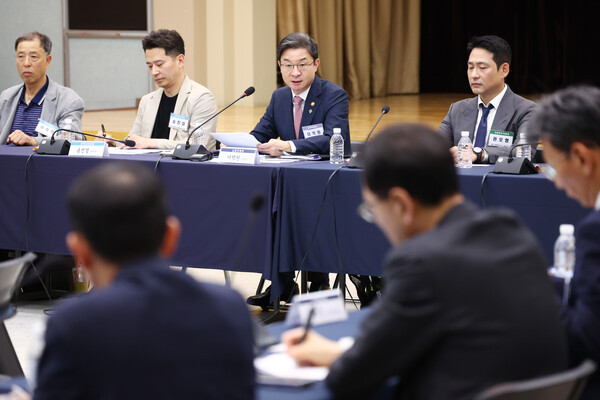
The Financial Services Commission said it held an "on-site inclusive finance debate" on Tuesday at the Korea Deposit Insurance Corporation in central Seoul, chaired by FSC Chairman Lee Eok-won (이억원).
Lee said inclusive finance is a structural reform task for the financial system, not a one-off livelihood measure. He said authorities need to examine the structure itself, including why people turn away at the threshold of mainstream finance and why a single delinquency leads to long-term delinquency.
The debate was held in two sessions. The first discussed the public role of finance and the direction of policies on finance for ordinary people. Lim Soo-kang (임수강), former vice chairman of the Production and Inclusive Finance Research Association, said finance is core infrastructure for the national economy, beyond a way for individual economic agents to raise funds. Participants also suggested that institutional incentives and public discipline should be 마련ed together so that the commercial and public nature of financial institutions operates in balance.
The second session discussed an inclusive redesign of the financial industry. Kang Kyung-hoon (강경훈), a professor at Dongguk University, said South Korea's finance has hardened into a risk-avoidance structure centered on real estate collateral and high-credit borrowers. He said this has led to a structural market failure in which small and medium venture companies and low-income groups are excluded from access to finance.
Ko Seok-heon (고석헌), a vice president at Shinhan Financial Group, cited high delinquency rates among mid- and low-credit borrowers as a constraint on expanding inclusive finance from the field's perspective. He proposed a virtuous cycle that combines quantitative expansion of inclusive finance, easing of interest burdens and stronger alternative credit scoring to turn non-prime customers into prime customers.
The debate was attended by advisers to the inclusive finance strategy task force and officials from related institutions including the Financial Supervisory Service, the Korea Inclusive Finance Agency, Korea Credit Information Services and Korea Asset Management Corporation. Field experts from Rolling Jubilee, Shinnaneun Johap and financial welfare counseling support centers also took part to discuss how policy users perceive the measures and tasks for improving the system.
The FSC plans to reflect the views raised at the debate in the agenda for discussions by subcommittees of the inclusive finance strategy task force.
The FSC said it will submit tasks as reviews are completed to the "Inclusive Finance Great Transformation Meeting" and turn them into policy. It said it will run the process so the public and markets can verify it by disclosing discussions from identifying tasks to preparing alternatives and improving the system.
 Ji-young Lee
ljy@d-today.co.kr
Ji-young Lee
ljy@d-today.co.kr