
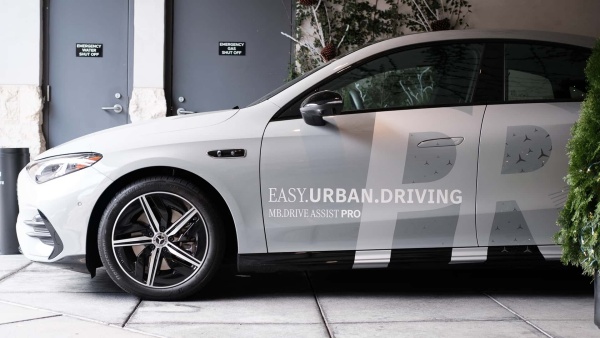
Mercedes-Benz has unveiled a new advanced driver assistance system (ADAS) designed to handle city environments as well as highways. Mercedes recently demonstrated real-world city driving performance of MB.Drive Assist Pro on a next-generation CLA Class prototype in San Francisco.
On Jan. 5, electric-vehicle outlet InsideEVs reported the system aims to handle urban intersections, roundabouts, heavy traffic flow and parking manoeuvres, unlike existing ADAS focused on highways. Mercedes described it as “not a technology that replaces the driver, but a cooperative partner that reduces risks and burdens in city driving.”
MB.Drive Assist Pro applies Nvidia Drive AV software with enhanced Level 2 point-to-point driver assistance. A key feature is that the driver must always keep hands on the steering wheel and watch the road. Unlike some competitors that aim for hands-free driving, Mercedes is sticking to the view that hands-on is central to safety in city environments.
Lucas Bolster, Mercedes manager for automated and assisted driving, said reaction time can lengthen the moment a driver takes hands off during city driving. He said keeping the driver in a state where intervention is possible is important to achieving safety goals.
The hardware configuration is also aggressive. The CLA prototype is equipped with 10 cameras, 5 radars, 12 ultrasonic sensors and an Nvidia-based high-performance onboard computer. Mercedes said it is training AI by combining driving data collected from real vehicles with simulations, and is running redundant algorithms in parallel to minimise the likelihood of recognition errors. It also plans to continuously improve performance through quarterly over-the-air software updates.
MB.Drive Assist Pro differs from Tesla's camera-based approach. Tesla has chosen a camera-and-AI-focused vision-only strategy, but Mercedes argues that multi-sensor fusion combining cameras, radar and ultrasonic sensors is a solution that can ensure safety in city driving.
Ali Kani, head of Nvidia's automotive platform business, said there is no passenger car on the market with the level of safety and redundancy Mercedes has presented. He said it is solving a problem the industry has tried to tackle for years.
In a test drive in downtown San Francisco, the CLA prototype handled complex situations relatively naturally, including stopping at intersections, making unprotected left turns, yielding to pedestrians and electric bicycles, and avoiding double-parked vehicles. It also analysed the movement of other vehicles' headlights to judge whether they were parking, and predicted oncoming vehicles' intentions before entering safely.
The system also offers a Cooperative Steering function that allows the driver to intervene directly on the steering wheel at any time. If the driver wants to drive more actively, it is possible to override the system, and there are no restrictions or disadvantages as a result.
Still, the system does not aim for full self-driving. Mercedes already offers Level 3 technology on a limited basis, but has made clear that driver supervision is essential in city environments. Bolster said driving in an unfamiliar city is stressful, and said supervising the system can be psychologically more comfortable than operating everything directly.
MB.Drive Assist Pro will be applied first to the CLA Class and later expanded to other Mercedes models. Pricing has not been disclosed, but it is likely to be offered as a vehicle purchase option or a subscription service.
Mercedes sees the key question as whether consumers accustomed to highway-focused hands-free systems will accept the value of city-type ADAS. Even so, the company said it is confident in market potential, calling it “a technology that provides drivers with real comfort and safety.”
 Jinju Hong
hongjj@d-today.co.kr
Jinju Hong
hongjj@d-today.co.kr