
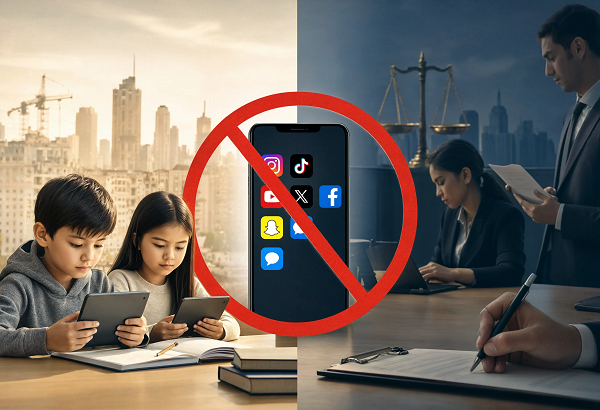
Despite doubts about how effective it will be, more countries have introduced or are preparing measures to ban social media for minors. Moves to prohibit or restrict social media use by children and teenagers appear to be spreading across countries, regardless of whether they are developed or developing.
Britain, following Australia and Malaysia, will ban the provision of social media services to minors under 16. The move comes as parents and the education sector call on governments and tech companies to act more proactively to protect children and teenagers online.
The British government plans to submit to parliament before Christmas a rule banning social media use for all children under 16 and to implement the ban in early 2027. Platforms covered include Snapchat, TikTok, YouTube, Instagram, Facebook and X (Twitter).
British Prime Minister Keir Starmer said, "This ban may not be perfect and it will cost money, but the role of government is always a matter of choice, and it is clear that a blanket ban is the right choice."
The British government earlier began collecting public opinions on the issue in March and received more than 116,000 submissions from parents, teenagers, industry groups and experts.
A YouGov survey conducted in December showed 74 percent of Britons said they supported the social media ban.
Australia in December last year became the first in the world to implement a measure banning under-16s from using social media apps such as Snapchat, Facebook and TikTok. In January, Australia’s regulator announced that social media companies had deleted about 4.7 million accounts belonging to children under 16.
The Australian government’s move drew attention from several other countries, including Britain. Britain plans to adapt the Australian model to suit its own circumstances.
Britain plans to go a step further than the Australian-style regulation by restricting under-16s from using live streaming and from communicating with strangers on those platforms. This will apply not only to social media but also to game sites and other services.
After Australia, Malaysia also began enforcing a rule in June banning under-16s from having social media accounts. The Malaysian government announced the plan in November last year and acted on it about six months later. According to The Associated Press, age verification procedures for existing users are to be introduced in stages over the next six months. Companies could face fines in the process, but parents are excluded.
Indonesia’s National Police said it also began enforcing a new rule in March banning children under 16 from using so-called "high-risk platforms" such as TikTok, YouTube, Facebook, Instagram and Roblox (Roblox).
In Brazil, a law to protect children from addictive, violent and obscene online content took effect in March. Under the law, children under 16 must link their accounts to a legal guardian, and guardians will be able to supervise children’s social media use.
Moves toward banning social media for children and teenagers are also taking concrete shape in European Union member states.
Spanish Prime Minister Pedro Sanchez announced a plan in February to require platform operators to adopt an effective age verification system. The plan would need parliamentary approval to become reality.
In France, a ban on social media use for children under 15 could take effect around the start of the new school year in September. The plan has broad support across party lines, and President Emmanuel Macron also strongly supports it, the New York Times reported.
Denmark in November last year announced a plan to ban certain social media platforms for teenagers under 15. Those aged 13 and older can use social media with parental permission.
Austria’s government in March announced plans to ban social media use for children under 14, and Greek Prime Minister Kyriakos Mitsotakis said in April that a bill banning social media use for children under 15 would take effect on Jan. 1, 2027. There is little opposition to the bill and it is expected to pass this summer, the New York Times reported.
In the United States, the Children’s Online Privacy Protection Act (COPPA, Children’s Online Privacy Protection Act) bars companies from collecting personal information from users under 13. But a blanket ban on social media for children does not appear easy to implement because each state has its own laws. But attacks on social media platforms are gaining momentum in the private sector. In March, a social media addiction lawsuit against Meta, which operates Instagram, and Google, which operates YouTube, also resulted in a victory for a 20-year-old female plaintiff.
Meta, YouTube lose social media addiction lawsuit as negligence liability is recognized
It remains unclear whether measures banning social media use by children and teenagers will be effective. According to a New York Times report, in Australia, six months after the under-16 social media ban took effect, many younger teenagers are still using the services through workarounds.
Some teenagers drew moustaches to avoid age-estimation scans or created new accounts using false dates of birth. Others use parents’ or siblings’ accounts, or continue using their own accounts without any problems.
Even so, some believe the ban could have some effect over the long term. It could have a positive impact on the next generation, even if not now. Some parents believe the real impact of the ban could be on children who are not yet using social media, and that the restrictions could make it more likely they will continue not to use it in the future, the New York Times reported.
 Chi-gyu Hwang
delight@d-today.co.kr
Chi-gyu Hwang
delight@d-today.co.kr