
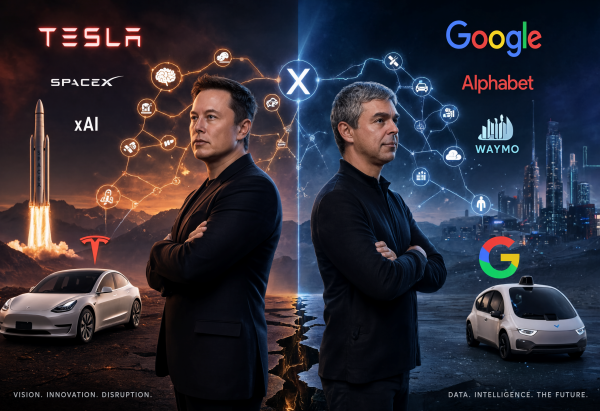
SpaceX and Google have moved closer in business ties through an artificial intelligence (AI) infrastructure contract. Unlike the personal relationship between Elon Musk and Google co-founder Larry Page, who once clashed publicly over AI risks, the two companies are expanding cooperation in AI and cloud businesses.
CNBC reported on June 14 that SpaceX, ahead of an initial public offering (IPO), signed a 32-month contract with Google to supply AI infrastructure worth $920 million a month. If the contract is maintained, SpaceX would secure about $30 billion in additional revenue.
The deal is attributed to rapidly rising demand for Google's AI services. Google has moved to secure additional computing resources as demand for its enterprise AI platform, Gemini Enterprise, has been increasing faster than expected. Google Cloud described the agreement as "securing bridge capacity to meet growing customer demand."
The contract includes conditions. If SpaceX fails to secure the agreed level of AI chip supply capacity by Sept. 30, Google can terminate the contract after a one-month grace period. After the end of this year, either side can cancel the contract with 90 days' notice.
The companies' ties go back years. In 2015, Elon Musk and Larry Page were known to have grown distant after publicly revealing differences over the future and risks of AI. But in the same year, Google invested about $900 million in SpaceX.
Alphabet currently holds about a 4.9 percent stake in SpaceX. The value of that stake has recently been assessed as exceeding $100 billion after SpaceX's listing. It is cited as one of Alphabet's most successful investments among its private holdings.
The partnership is not the first between the two. In 2021, SpaceX signed a cloud and network infrastructure deal with Google to operate its Starlink satellite internet service. At the time, SpaceX used Google's fiber-optic network to enhance Starlink's connectivity and data processing performance.
But competition continues separately from cooperation. Musk publicly mentioned the need to check Google DeepMind when he co-founded OpenAI with Sam Altman in 2015. OpenAI later grew into a key company in the generative AI race by recruiting researchers from DeepMind.
The two are also rivals in autonomous driving. Google's affiliate Waymo is currently operating robo-taxi services involving thousands of vehicles in major U.S. cities and handling more than 500,000 paid rides a week.
Tesla, by contrast, is expanding robo-taxi services centered on Austin, Texas, but has yet to commercialize fully autonomous driving services that do not require driver supervision. Musk has criticized Waymo's lidar-centered approach and has argued that camera-based autonomous driving is more efficient.
The industry views the deal as an example showing how interests between competing companies are intricately intertwined during the AI industry's growth.
Google has become a major shareholder in SpaceX as well as a large customer, while SpaceX has emerged as a key supplier supporting Google's demand for AI infrastructure. Despite personal conflict and business competition, the two companies have become important partners for each other in the AI and cloud markets.
The market sees the possibility that the partnership could expand further if demand for AI infrastructure continues to rise.
 Jinju Hong
hongjj@d-today.co.kr
Jinju Hong
hongjj@d-today.co.kr