
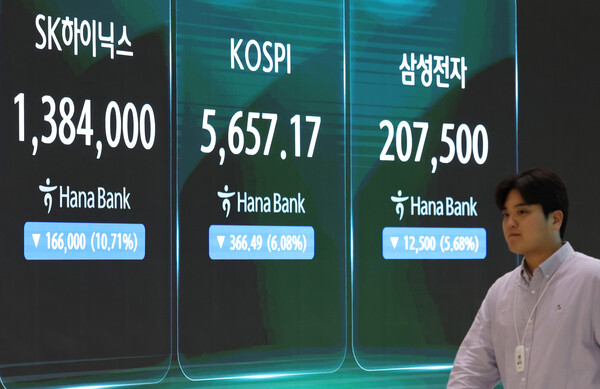
South Korean stocks plunged for a second straight day, triggering sell-side sidecars and circuit breakers. The KOSPI fell as far as the 5,200 level during the session before paring losses, but it did not regain 6,000, and the Kosdaq slid more than 6 percent.
On July 29, the KOSPI closed down 360.42 points, or 5.98 percent, at 5,663.24. The index opened up 65.45 points, or 1.09 percent, at 6,089.11 and rose to 6,228.52 early in the session. Selling then flooded the market and it dropped as low as 5,262.77.
Individuals and foreigners were net sellers in the main board market, unloading 1.9767 trillion won and 1.2157 trillion won, respectively, dragging the index lower. Institutions were net buyers of 3.1606 trillion won, helping limit the downside.
The Kosdaq closed down 43.17 points, or 6.12 percent, at 662.68. It fell as low as 649.00 during the session, briefly slipping below 650.
Sell-side sidecars and a first-stage circuit breaker were triggered in both markets, following similar moves a day earlier.
In the main board market, program sell orders were halted for 5 minutes after KOSPI 200 futures fell 5.15 percent below a reference price at 10:55:07 a.m. In the Kosdaq market, a sell-side sidecar was triggered after Kosdaq 150 futures fell 6.21 percent at 10:56:07 a.m.
As selling continued, a first-stage circuit breaker was triggered on the Kosdaq at 12:19:12 p.m. At the time, the Kosdaq was down 8.05 percent from the previous session at 649.00.
In the main board market, trading was halted for 20 minutes after the KOSPI fell 8.15 percent to 5,532.33 at 12:32:32 p.m.
On July 28, sell-side sidecars and circuit breakers were triggered in both markets. It was the first time in South Korean market history that circuit breakers were triggered simultaneously in the KOSPI and Kosdaq for two consecutive trading sessions. It was also the first time a circuit breaker was triggered for two straight days in the main board market.
Top market-cap stocks also fell across the board.
Samsung Electronics closed down 5.23 percent at 208,500 won, while SK Hynix ended down 9.61 percent at 1,401,000 won.
SK Square fell 8.11 percent, Samsung Electro-Mechanics dropped 7.63 percent and Samsung Life slid 6.84 percent. Samsung Biologics and LG Energy Solution also fell 4.52 percent and 4.30 percent, respectively.
Hyundai Motor closed down 2.88 percent at 353,500 won, while KB Financial Group ended down 3.09 percent at 160,100 won.
In Seoul's foreign exchange market, the dollar-won exchange rate was 1,446.90, down 8.30 won from the previous session. The won strengthened against the dollar despite the sharp fall in local shares.
Market participants analysed that forced selling expanded as expectations for SK Hynix's second-quarter earnings weakened, uncertainty over U.S.-Iran negotiations persisted, and hopes for a rebound after the previous day's sharp drop were dashed. Rising trading in single-stock inverse products was also cited as a factor that increased intraday volatility.
Han Ji-young (한지영), a researcher at Kiwoom Securities, said the essence of the plunge was panic selling as stockholders locked in losses after expectations for a rebound following a 10 percent drop a day earlier faded. She said it was necessary to check whether potential catalysts for a rebound, including earnings by major U.S. technology companies, the Federal Open Market Committee and U.S.-Iran negotiations, were changing rather than joining forced selling.
 Sangyeob Oh
yub@d-today.co.kr
Sangyeob Oh
yub@d-today.co.kr