
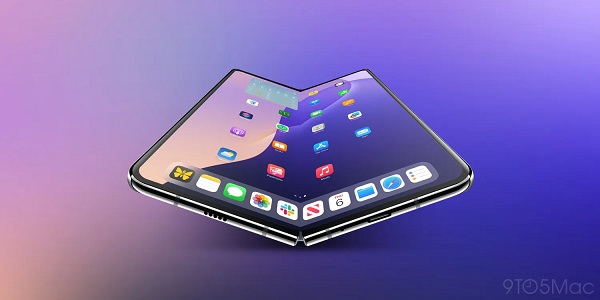
[DigitalToday reporter Yoonseo Lee (이윤서)] Apple may introduce its first foldable iPhone this fall under the name "iPhone Ultra".
An IT outlet, 9to5Mac, reported on June 11 that the product is expected to incorporate changes from existing iPhones in design and display, camera, software, chip and biometric authentication.
The key change is the form factor. Unlike typical foldable phones, the iPhone Ultra is expected to adopt a "book-style" design that is wider horizontally than vertically when unfolded. The outer display is expected to have a shorter and wider ratio than existing iPhones, while the inner display is said to be similar to the iPad mini in size and shape. The inner screen may also use a design that minimises creasing.
The exterior is expected to reflect some design elements of the iPhone Air. Observers say it could use a titanium bezel and an ultra-thin structure to reduce thickness when folded.
The displays are expected to be about 5.3 to 5.5 inches on the outside and 7.6 to 7.8 inches on the inside. The outer screen is described as feeling similar in size to an iPhone mini but with a wider aspect ratio, while the inner screen could feel closer to an iPad mini when held.
The camera setup is likely to include 2 rear cameras and 2 front cameras. The rear is expected to include a 48-megapixel wide camera and a 48-megapixel ultrawide camera, with the telephoto camera possibly omitted. One front camera is expected on each display, and the screen is expected to use a hole-punch design.
On software, iOS 27 features tailored to the foldable form factor are likely to be added. Key functions include multitasking that places multiple apps side by side and an iPad-style app layout. It is not expected to run iPadOS when unfolded or to support iPadOS 26’s full window mode function as it is, the report said.
On performance, it is expected to include the A20 Pro chip and the C2 cellular modem, the same as the iPhone 18 Pro. The A20 Pro is expected to improve efficiency by using a 2-nanometre process and a wafer-level multi-chip module. The memory is said to be 12GB of RAM, and it was also suggested that LPDDR5, a step-up model, could be used to boost performance.
For biometric authentication, Touch ID integrated into the power button is seen as more likely than Face ID. Analysts say the device’s thin structure would make it difficult to include Face ID components for both screens.
Price estimates for the iPhone Ultra vary widely. For a 256GB model, around $1,999, or about 3.04 million won, is being mentioned, but the actual launch price could differ depending on storage, parts costs, tariffs and regional pricing policies.
The key point in this outlook is that Apple is preparing its first foldable iPhone not as a simple screen-expansion product, but as a new type of device that links iPhone and iPad usability. iOS 27-based multitasking and whether Touch ID returns are expected to be key factors in determining the product’s completeness.
 Yoonseo Lee
yslee@d-today.co.kr
Yoonseo Lee
yslee@d-today.co.kr