
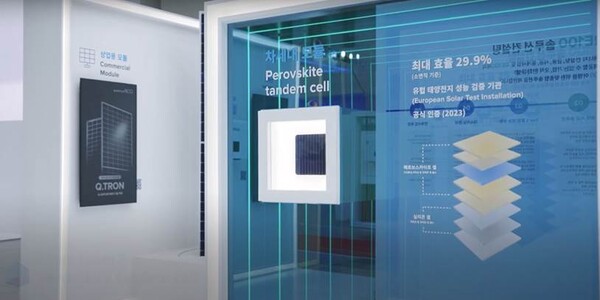
Hanwha Q CELLS has entered a stage to verify whether next-generation solar cell technology can be applied in space in an actual lunar environment. Hanwha Solutions' Q CELLS division said on Tuesday its German unit will participate as a partner in SSTEF-1, a NASA-backed space technology demonstration program, and provide perovskite-based tandem cell samples.
SSTEF-1 is a program led by U.S. company Aegis Aerospace. Georgia Tech Research Institute (GTRI), a nonprofit applied research institute under the Georgia Institute of Technology, is responsible for demonstrating solar cell performance in the space environment. GTRI selected Hanwha Q CELLS' tandem cells as the demonstration product, the company said.
GTRI plans to install Hanwha Q CELLS tandem cell samples on the surface of a lunar lander and expose them to the space environment to secure demonstration data. It will comprehensively evaluate the stability and reliability of the tandem technology under conditions different from those on Earth, including vacuum, extreme temperature fluctuations, ultraviolet light and space radiation. Hanwha Q CELLS plans to use the data to specify the direction of research and development for space solar power technology.
Tandem cells can deliver efficiency comparable to existing space-grade cells while reducing weight for the same installed capacity, which can lower launch and operating costs. Hanwha Q CELLS is developing terrestrial tandem products, targeting commercialization in 2029. The tandem technology uses a structure in which a perovskite top cell and a silicon bottom cell each use light in different wavelength bands, enabling higher generation efficiency than single-junction silicon modules.
Hanwha Q CELLS also said it became the first in the world to obtain International Electrotechnical Commission (IEC) certification for a terrestrial perovskite-based tandem module. It passed all categories of reliability assessment, including ultraviolet exposure, thermal cycling, damp heat and damp freeze, through global solar certification body TUEV Rheinland. Hanwha Q CELLS CEO Seungdeok Park (박승덕) said, "Space solar power is a platform industry with a major ripple effect across key industries closely linked to security, such as AI data centers, defense and communications," adding, "We will move forward to become a global renewable energy solutions company that opens the era of space solar power."
 Daegeon Seok
d2dg@d-today.co.kr
Daegeon Seok
d2dg@d-today.co.kr