
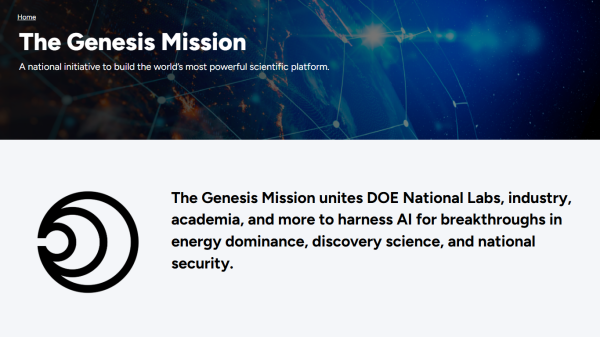
Japan will take part in the U.S. government’s artificial intelligence (AI) research project Genesis Mission as its first overseas partner.
Major foreign media outlets, including blockchain media Cryptopolitan, reported on Sunday local time that the United States and Japan plan to invest $1 billion over five years to jointly develop technology to accelerate scientific research.
With the cooperation, Tokyo will formally join Washington’s efforts to get ahead of China in AI and related technologies. Senior officials from Japan’s Ministry of Education, Culture, Sports, Science and Technology and the Ministry of Economy, Trade and Industry are due to visit the United States in early June to officially announce cooperation measures with the Department of Energy, which oversees Genesis Mission.
Genesis Mission is a government-led AI programme launched by U.S. President Donald Trump through an executive order in late 2025. The executive order instructed federal agencies to unify AI research tasks, computing infrastructure and datasets that were scattered across the government into a single system. The United States aims to link national laboratory supercomputers and scientific data with AI systems to raise the speed of experiments, simulations and calculations.
The programme covers 26 application areas. They include semiconductor development, biotechnology, nuclear fusion and quantum technology. The White House has compared the project’s scale and goals to the Manhattan Project and the Apollo program. At its launch in December 2025, 24 companies participated, including OpenAI, Nvidia, Microsoft (MS), Amazon Web Services (AWS) and Google.
The U.S. government is highlighting improved research productivity as Genesis Mission’s key effect. White House Office of Science and Technology Policy Director Michael Kratsios said in December last year the initiative would dramatically raise the productivity of U.S. scientists and researchers. He said it would help automate experiment design, accelerate simulations and generate predictive models.
Japan will emphasize its strengths in the cooperation. Japan has capabilities in materials science, robotics and semiconductor manufacturing, and those fields directly align with Genesis Mission’s 26 focus areas. The arrangement would have the United States provide research infrastructure and large-scale AI systems, while Japan adds manufacturing and industrial-technology foundations.
Overseas cooperation was reflected in the programme’s design from the start. The executive order launching Genesis Mission directed the National Science and Technology Council, together with the Office of Science and Technology Policy, to find overseas partners whose research capabilities match the programme’s goals. Japan became the first foreign government to participate under that standard.
The partnership is expected to be followed by institutional adjustments. The executive order stipulates that the energy secretary review and update research priorities every year. It also called for standardized rules for cooperation related to data access, cybersecurity, intellectual property rights and export controls. With Japan entering as the first overseas partner, the operating framework is more likely to be adjusted again on the premise of international cooperation.
The agreement also intersects with a trend in which AI competition is expanding across national research and development systems and the broader industrial supply chain. Attention is focused on whether the scope of U.S.-Japan cooperation will widen in fields such as semiconductors, quantum and bio, where research and manufacturing must move together. At the official announcement expected in early June, the key issues are likely to be the two sides’ specific division of roles, joint research methods, and data and security standards.
 Jinju Hong (홍진주)
hongjj@d-today.co.kr
Jinju Hong (홍진주)
hongjj@d-today.co.kr