
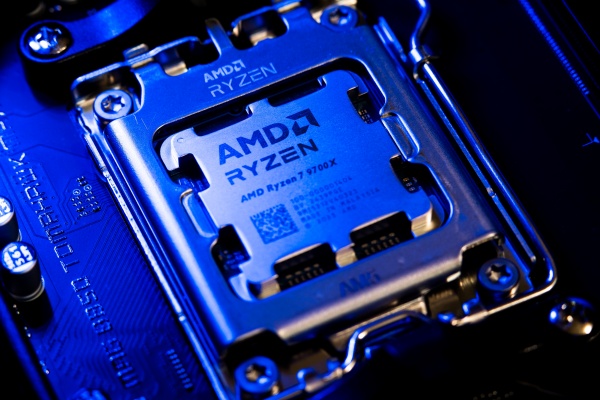
[DigitalToday reporter Jinju Hong (홍진주)] AMD has decided to extend support for AM5, its desktop CPU socket platform, to at least 2029. The longer upgrade window lets users move to next-generation Ryzen processors without replacing the motherboard, as AMD continues to differentiate itself from Intel in platform lifespan competition.
On June 1 (local time), IT outlet Ars Technica reported that AMD recently announced at Computex that it will extend its AM5 platform support roadmap beyond its previous plan. AMD originally planned to support AM5 through 2025, later increased the period to 2027 or beyond, and has now disclosed a policy to support it until at least 2029.
The key point is that consumers using existing AM5 motherboards will have less need to replace the entire system when upgrading to future Ryzen processors.
AMD has previously received positive assessments for maintaining a long-term socket compatibility policy on the AM4 platform. AM4 supported multiple generations of Ryzen processors after its 2017 launch, significantly lowering upgrade costs.
AMD stressed that the AM5 extension is a continuation of that strategy. The company explained, "The promise of long-term support for Socket AM5 is in the same context as the long-standing support philosophy for the AM4 platform." AMD also said it plans to support processors based on its next-generation Zen 6 architecture on the AM5 platform as well.
The industry sees Zen 6 as possibly increasing the core count of Ryzen desktop processors, currently up to 16 cores, to as many as 24 cores. Actual product specifications have not been disclosed yet, but a significant performance improvement is expected in content creation or development work environments where multicore performance is important.
Still, the possibility remains that AMD could extend platform life not only through entirely new CPU generations but also through derivative models of existing products.
Along with the platform support extension, AMD also unveiled a new processor. The company announced the Ryzen 7 7700X3D, targeting the entry-level gaming market. The 8-core 3D V-Cache processor will launch on July 16 and is priced at $329.
The 7700X3D is about $50 cheaper than the Ryzen 7 7800X3D and is priced more than $100 lower than the currently sold Ryzen 7 9800X3D. Its maximum boost clock is 4.5 GHz, lower than higher-end models, but it uses AMD's 3D V-Cache technology, which is expected to improve gaming performance. Reviews say the added 64MB L3 cache can reduce CPU bottlenecks and help improve frame performance.
AMD also introduced a product for its existing user base. The company said it will re-release the Ryzen 7 5800X3D, which had been a flagship gaming CPU for the AM4 platform, as a 10th anniversary edition. The product is priced at $349 and is set to launch on June 25.
The 5800X3D is AMD's first commercialized 3D V-Cache processor. It may deliver lower performance than newer products in general productivity work, but it is assessed as still offering competitive performance in gaming.
The industry analyzes that AMD's decision to expand support for the newer AM5 platform while also re-releasing a product for AM4 users stems from the recent rise in PC upgrade costs. As prices for graphics cards, memory and motherboards rise, consumers are feeling the burden of replacing entire systems. AMD also explained that "a longer platform lifespan can reduce the need for full system replacement and increase the value of consumers' investment."
The market is focused on how many additional generations of Ryzen processors the AM5 platform will actually support going forward. Another key point is how much Zen 6-based processors, through a higher core count, can stimulate upgrade demand.
The industry sees AMD as seeking to strengthen its competitive edge in the PC upgrade market by pursuing long-term support for its new platform while maintaining its existing platform strategy at the same time.
 Jinju Hong
hongjj@d-today.co.kr
Jinju Hong
hongjj@d-today.co.kr