
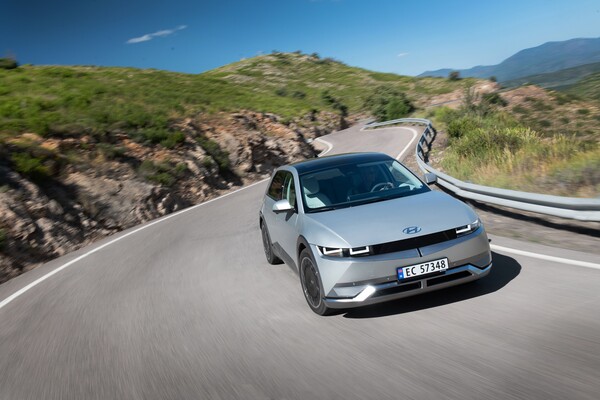
[Digital Today reporter Jinju Hong (홍진주)] Hyundai Motor's electric SUV Ioniq 5 recorded a lower total cost than a gasoline SUV on a long-distance trip in the New York area, even using only public fast charging. The result is being seen as an example showing that EV cost advantages are not limited to home charging.
InsideEVs, an EV-focused outlet, said on June 1 that the total cost of a roughly 560-mile (about 900 km) round trip from New York City to upstate New York and the Adirondack region was $620 (about 930,000 won).
The comparison was based on actual travel costs including vehicle rental, charging and tolls. The Ioniq 5 rental cost for 3 days was $480. Adding $60 in tolls and about $80 in charging brought the total to $620.
Under the same conditions, a gasoline SUV with fuel economy of about 25 miles per gallon cost about $103 in fuel alone, and the total including rental topped $750 (about 1.13 million won). A hybrid crossover with fuel economy of about 40 miles per gallon had lower fuel costs of about $64, but its higher rental cost put the overall trip cost at more than $700.
The vehicle used for the test was an older all-wheel-drive (AWD) Ioniq 5 model. It had a 77 kWh battery and an estimated range of about 260 miles under U.S. Environmental Protection Agency (EPA) standards. The vehicle used a CCS charging port rather than the latest North American Charging Standard (NACS), but the outlet reported no major inconvenience during long-distance travel.
The occupant cited the Ioniq 5's quietness, ride comfort and charging speed as strengths. The Ioniq 5 is based on Hyundai Motor Group's 800-volt EV platform, and it can charge from 10 percent to 80 percent in about 20 minutes when using a 350 kW ultra-fast charger.
Charging was carried out 3 times during the trip. The first charge was at a 350 kW station about 100 miles (about 160 km) north of New York, costing about $31 to charge from 14 percent to 92 percent.
About $20 was spent on an additional charge before entering mountainous areas, and the main charging costs, including charging on the return trip, were about $67. Additional charging to match the initial charge level before returning the vehicle brought total charging costs to about $80.
It was also noted that every charging stop naturally overlapped with meal or rest breaks. The driver said there was no separate charging plan or energy-saving driving, and that air conditioning was used actively and charging was done with ample margins. Even so, the overall cost came out better than a gasoline SUV.
The results are also related to recently high gasoline prices in the New York area. The local average gasoline price was calculated at about $4.58 per gallon.
InsideEVs analysed that, under these conditions, an internal combustion vehicle would need fuel economy of at least 32 miles per gallon to achieve a similar driving cost to the Ioniq 5. It said that would be difficult for a typical midsize SUV.
The industry sees the case as one that could overturn the perception that EV cost advantages depend only on home slow charging. It highlighted that EVs showed competitiveness in total cost even under relatively unfavourable conditions such as long-distance holiday travel, reliance on public fast charging, and areas with high electricity and gasoline prices.
Experts forecast that EV cost advantages for long-distance travel will increase further if charging infrastructure expands and battery performance improves.
 Jinju Hong
hongjj@d-today.co.kr
Jinju Hong
hongjj@d-today.co.kr