
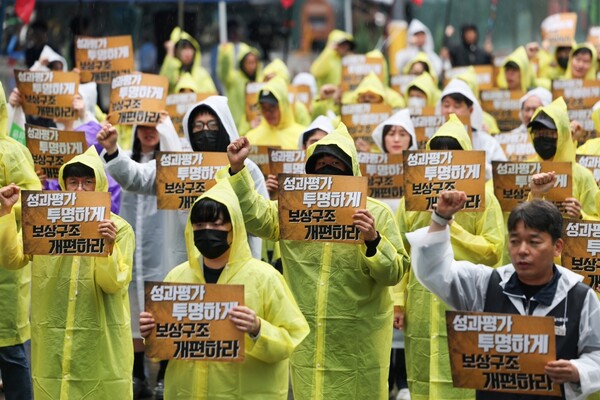
Kakao's labour-management conflict has entered a phase that could lead to the company's first-ever headquarters strike. The Kakao union plans to begin with a four-hour partial strike on June 10 and raise the level depending on bargaining. What started with a breakdown in bonus talks has expanded into job security, compensation systems and organisational restructuring, becoming a test of Chief Executive Jeong Shin-a (정신아)'s leadership.
The Kakao union plans a four-hour partial strike and a rally on June 10 around Pangyo Station in Seongnam. The rally was previously reported as involving about 1,200 members, marching from 9 a.m. to 4 p.m. around Pangyo Station and U-Space. The union plans to start with a partial strike rather than an immediate full walkout, then increase the strike level depending on later talks. The partial strike, with five units including headquarters participating jointly, will be the first such case since the company was founded.
Kakao headquarters and the union held a second mediation session on wage and bonus systems on May 27 at the Gyeonggi Labour Relations Commission, but failed to find common ground after about eight hours of talks. The headquarters union therefore secured the legal right to strike. Four affiliates including Kakao Pay, Kakao Enterprise, DK Techin and XL Games have also secured strike rights, and the strike will take the form of joint participation by five units combining headquarters and the four affiliates. The strike will begin at 10 a.m. for four hours.
COMPENSATION: From bonuses and RSUs to executives' compensation systems
The direct points of contention are the size of bonuses and whether restricted stock units, or RSUs, are included. The union is also putting forward as key demands improving compensation systems and halting sales, spinoffs and restructuring while securing job stability. The union says a management-centred compensation system must be changed because it causes job insecurity through wrong decision-making while monopolising overwhelming rewards. The two sides have failed to narrow differences over the bonus compensation structure and whether to include RSUs worth 5 million won in bonuses. In the industry, some interpretations say the union's demands amount to 13 to 15 percent of last year's operating profit.
Kakao issued a statement on May 29 saying the union's demands would be a major burden on management based on operating profit and would be hard to bear given the need to consider future investment capacity and shareholder value together.
The conflict is spreading beyond a simple gap in amounts to a question of predictability in compensation standards. The union is demanding clarification of the criteria for bonus payments and institutionalisation of the compensation system, while the company is reported to have only reaffirmed differences even after presenting multiple compensation proposals. With the two sides clashing over what standards and how calculations should be made rather than how much to pay, the talks are taking on the character of a struggle over who leads the design of the compensation system rather than a simple wage negotiation.
It also contrasts with Naver, which excluded bonus discussions from wage negotiations and agreed to a 5.3 percent increase in base pay. Naver reduced bargaining variables by raising annual pay by 8 million won each while ending its stock grant programme, increasing the share of fixed pay. At Kakao, the bonus structure and the criteria for including RSUs remained key issues throughout the talks.
TRUST: Distrust built up before the compensation dispute
Assessments say accumulated distrust from before played a role in the compensation issue becoming so sharp. In a statement on May 28, the union said the company remained passive throughout the bargaining period and claimed it "undermined trust in negotiations by unilaterally paying bonuses during the bargaining process, and the continuity of dialogue was shaken by repeated changes of bargaining representatives and insufficient revised proposals." The union defined the decision to halt mediation itself as "a result showing that trust between the company and members has collapsed."
The issue of executive compensation was also raised directly. The union claimed the combined compensation received by executives who had been involved in controversies, including former Kakao Pay CEO Ryu Young-joon (류영준), former Kakao CEO Hong Eun-taek (홍은택) and former Kakao Enterprise CEO Baek Sang-yup (백상엽), exceeded tens of billions of won. It said that while bonus standards for ordinary employees were operated opaquely, executives were paid bonuses worth hundreds of millions of won.
There is a longer context behind the erosion of trust. Kakao was found by the Ministry of Employment and Labor last year to have had employees work beyond the statutory cap on working hours during a major KakaoTalk overhaul, and allegations were also raised that it hired an external recruit into another job category and then switched them to a developer role. Assessments say distrust in leadership accumulated as past controversy over so-called "hit-and-run" gains from Kakao Pay executives exercising stock options and allegations of stock price manipulation during the SM Entertainment acquisition process were added. Reactions inside and outside Kakao that this labour dispute is the result of long-accumulated internal risks erupting at once are linked to this.
An industry official said, "Not being able to accept the criteria is a more fundamental issue than the bonus amount," adding, "If the criteria are opaque, the structure produces complaints even if the results are good."
ORGANISATION: Operational controversy exposed by CPO departure
As disputes over compensation and trust continue, Kakao's organisational structure has also wavered. It was confirmed that Chief Product Officer Hong Min-taek (홍민택), recruited from outside in February last year and overseeing the product organisation, left the company on May 31, reigniting internal complaints over externally recruited leadership. Hong led a major KakaoTalk overhaul including the introduction of a grid-style feed in September last year, but left after user backlash and controversy over triggering labour supervision.
The union criticised Hong, saying, "He triggered negative controversy over KakaoTalk updates and even sparked labour supervision in labour-management relations, but disappeared without any explanation." In the industry, internal backlash over recruiting external figures is cited as a factor that also influenced the end of the CPO system.
Kakao does not plan to appoint a new CPO after Hong's departure. Instead, it is pushing an overhaul that splits the existing product organisation into service and business areas and integrates design teams that had been dispersed. Details including responsible executives and specific appointments will be finalised sequentially. A "User First" task force will also be newly created within the KakaoTalk organisation to strengthen communication with users.
Kakao's move to separate service and business functions is interpreted as an effort to redefine balance by clarifying the roles of user experience and monetisation organisations. Still, if reorganisation proceeds while distrust over compensation standards remains unresolved, employee acceptance could be low regardless of the purpose of the overhaul.
FACTOR FOR PROLONGATION: Burden on development momentum rather than service stability
In the short term, many observers say it is unlikely that major services such as KakaoTalk and Kakao Pay will be immediately suspended. That is because key services are operated based on automated systems and essential staffing structures. Still, if the strike is prolonged or overlaps with unexpected outages, security issues or major updates, there could be pressure on the response capacity of skilled personnel and schedules for developing new features.
The essence of Kakao's labour conflict does not lie only in the size of bonuses. Raising the issue of opaque compensation standards has intertwined with controversy over executive compensation, and that distrust has spread into awareness of problems with an organisation operation model centred on externally recruited figures. Compensation is the starting point of the conflict, but trust is a structural factor that amplified it, and organisational reorganisation is a management task that emerged as a result.
June 10 is expected to be the first turning point in Kakao's labour conflict. The union plans to begin with a four-hour partial strike and strengthen the level of strikes step by step depending on the state of negotiations. It is not an immediate full walkout, but with a headquarters-level strike announced, Kakao faces a situation where it must simultaneously address KakaoTalk reorganisation, an AI transition and ensuring service stability amid labour-management conflict.
Another official said, "How Kakao resolves this conflict does not end with labour-management issues," adding, "If it cannot regain members' trust in the compensation system and the organisation operation model, even reorganisation or an AI strategy could lose momentum from within."
 Lee Ho-jung
lhj@d-today.co.kr
Lee Ho-jung
lhj@d-today.co.kr