
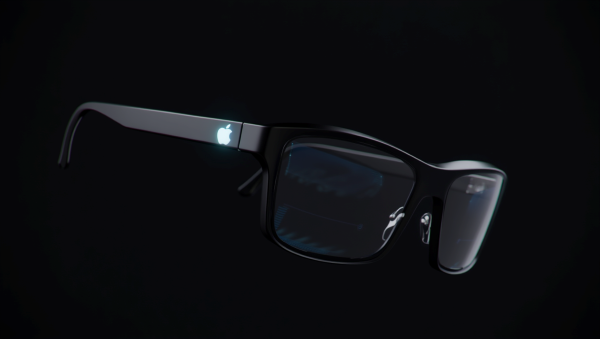
Apple's first smart glasses under preparation are said to be designed as a strategy targeting the overall eyewear market, not just competition with Meta.
On June 1, the online outlet Gigazine reported that Apple is planning to directly absorb new consumer demand through smart glasses in a way similar to when it entered the smartwatch market.
The key is the competitive landscape. Apple is said to be looking beyond Meta, a leader in the smart glasses market, and also taking in existing eyewear brands such as Oakley, Ray-Ban and Warby Parker. The approach is not simply to secure market share in the tech device market, but to change the choice of glasses people wear every day.
Bloomberg's Mark Gurman relayed Apple’s thinking, saying, "Apple seems to believe that its powerful brand, industrial design and iPhone integration features will lead people who are looking to buy new glasses to choose Apple products." He also cited an ecosystem based on more than 2 billion active devices, a global retail network and artificial intelligence features that help users interact with the world around them as factors that could support sales.
The pricing strategy is also tied to the plan to reshape the market. The price range currently being discussed is $200 to $500. Still, it is not confirmed whether Apple will stick with that range through to the end. Even so, the direction appears closer to general consumers than high-end luxury.
The strategy resembles Apple Watch’s early moves. When Apple launched the Apple Watch in September 2014, it set not only smartwatch makers such as Pebble and Motorola as rivals, but also traditional watchmakers such as Swatch, Fossil and Seiko. This time, it is also positioning smart glasses not as a category of existing electronic devices, but within the eyewear industry as a whole.
Market size was also presented as a backdrop for this judgment. Annual revenue from the Apple Watch is estimated at about $17 billion, but the eyewear market is seen as a larger opportunity. Market research firm Mordor Intelligence estimated the watch market at about $132 billion and the eyewear market at $180 billion to $200 billion.
Apple appears to be placing less weight this time on entering the premium market. In the past, Apple attempted to target the luxury watch market with the 'Apple Watch Edition' priced as high as 1.28 million yen, but it did not achieve major success and its official repair service ended in October 2023. Based on that experience, the possibility has been raised that Apple will focus on a mass-market product for smart glasses.
Late 2027 is being cited as a possible launch timing. If Apple moves ahead with the strategy, smart glasses could become a product that goes beyond device competition with Meta and takes on head-to-head the consumer goods market long led by traditional eyewear companies. Ultimately, the point to watch is whether Apple can redefine glasses as an everyday product beyond an electronic device by highlighting iPhone integration, its ecosystem and artificial intelligence (AI) features.
 Jinju Hong
hongjj@d-today.co.kr
Jinju Hong
hongjj@d-today.co.kr