
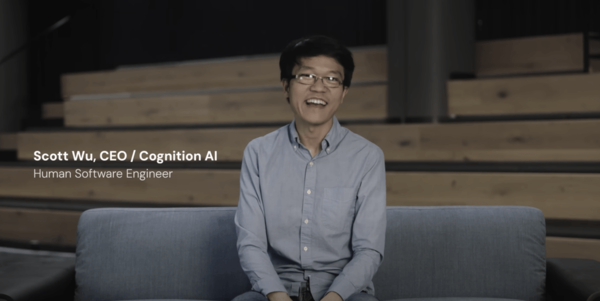
[DigitalToday reporter Jinju Hong] Scott Wu (스콧 우), CEO of startup Cognition, which developed the AI coding agent Devin, drew a line under interpretations that AI will replace human developers. He said the role of AI coding tools is not to eliminate jobs but to raise developer productivity.
On May 29 (local time), IT outlet TechCrunch reported that Wu said in a recent interview, "We have never thought of this as replacing humans," adding, "There are people who talk about that scenario, but our perspective was not that from the start."
Cognition has drawn attention by promoting the concept of "self-driving software engineering" with Devin, its AI coding agent. It recently succeeded in raising new funding worth $1 billion after being valued at $26 billion.
Devin aims to be an autonomous agent that carries out development work from start to finish, rather than a simple code-assistance tool. Because of that vision, the industry has repeatedly raised forecasts that AI could replace a significant part of software developers' roles.
Wu, however, stressed that Devin's goal is not to reduce developers but to expand development capability. He said, "We are all programmers," and introduced that he also started coding from the age of 9. He added, "The future we imagined was not getting rid of developers, but helping make more software," and said, "Devin is like a friend that helps developers."
Devin accounts for a significant share of its use inside Cognition. The company said 89 percent of code committed by engineers was written by Devin. Most of the remainder is handled by a local agent from Windsurf, an AI coding startup the company acquired last year.
That effectively means AI writes most of the software the company produces, but Wu argued it should not be linked to a shrinking role for human developers.
He pointed to maintenance work as the area where AI agents deliver the greatest value. He said they take on repetitive tasks developers relatively avoid, such as updating old systems to fit modern environments or migrating applications to other platforms. "Agents will take away a lot of hard work," Wu said. "As a result, programmers can focus on more important tasks such as creation and design."
He also cautioned against excessive expectations about Devin's actual capabilities. He assessed Devin's current level as somewhere "between a junior engineer and a mid-level engineer," depending on the type of work. That means it is still too early to view it as an AI at the level of a senior developer with full autonomy.
Cognition's "self-driving software engineering" refers to a direction in which AI agents continually learn and improve to gradually handle more complex work. Wu made clear the principle that final decision-making authority must remain with humans. "What to do must always be decided by humans," he said, adding, "This principle should apply not only to software development but also to other jobs."
Cognition expects AI agents to spread into a range of industries, including customer service and healthcare. It said the focus should remain on AI reinforcing humans, not replacing them, even in that process.
As generative AI gradually gains higher levels of autonomy, Cognition is delivering the message that human control and creativity will remain core values even in the era of AI agents.
 Jinju Hong
hongjj@d-today.co.kr
Jinju Hong
hongjj@d-today.co.kr