
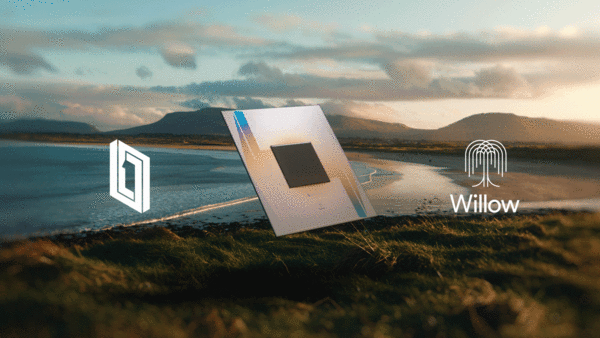
A research team at Britain's King's College London has secured early access to Google's next-generation quantum chip, Willow.
An online outlet, Gigazine, reported on May 29 that the team was announced as the first beneficiary through an early-access programme run by Google's Quantum AI research organisation and the UK's National Quantum Computing Centre.
The selected team is led by Dr. Eleanor Crane (엘리너 크레인) of King's College London's physics department. The team plans to use Willow to model and study quantum analogues of brain neurons. It set out a goal of opening a new research path combining computational neuroscience and quantum-correspondence modelling.
Willow is a 105-qubit quantum chip developed by Google's Quantum AI research organisation. While conventional computers are based on binary calculations of 0 and 1, quantum computers use qubits that can represent 0 and 1 at the same time. Because qubits are vulnerable to external influence and errors occur easily, quantum error correction has been cited as a key challenge.
Google presented exponential improvements in quantum error correction and ultra-fast computing results when it unveiled Willow in 2024. It said in 2025 it proved the chip can perform calculations 13,000 times faster than the world's fastest supercomputer. The early-access programme is seen as a process linking such performance to real-world research settings.
The programme began in December 2025. Research teams had to submit experimental plans to be carried out on Willow, and access is decided through a review. The deadline for submissions was initially set for May 15, 2026, and the deadline to notify selection results for July 1, but King's College London was first to have its selection made public on May 26.
Based on this access, the team will examine potential applications as well as basic research. King's College London expects the research could become the basis for better solar cells, more efficient power-grid systems and the search for new drugs to treat disease. The direct research focus in the announcement is on modelling work dealing with quantum analogues of neurons.
Crane said she was happy to work with Google again and said the project challenges the limits of how far quantum computers can surpass conventional computers. She also said there is not much hardware in the world that can run such complex simulations and expressed deep gratitude to the National Quantum Computing Centre and Google for the opportunity.
Google also made clear its willingness to support the research. Karina Chou (카리나 차우), chief operating officer of Google Quantum AI, said quantum computing has the potential to become a new tool for scientific advances in various areas where conventional computing hits fundamental limits. She said King's College London presented an attractive research proposal with support from the National Quantum Computing Centre, and said Google would provide quantum computing resources and expertise to accelerate the research.
The selection is meaningful in that Google has begun expanding quantum chip performance beyond laboratory demonstrations to real research tasks at external institutions. It also confirmed that, with the UK's National Quantum Computing Centre participating as an intermediary, access to Willow is being operated as an institutionalised programme rather than individual collaboration. If further selections and research results emerge, Willow's range of use is expected to be specified in more detail.
 Jinju Hong
hongjj@d-today.co.kr
Jinju Hong
hongjj@d-today.co.kr