
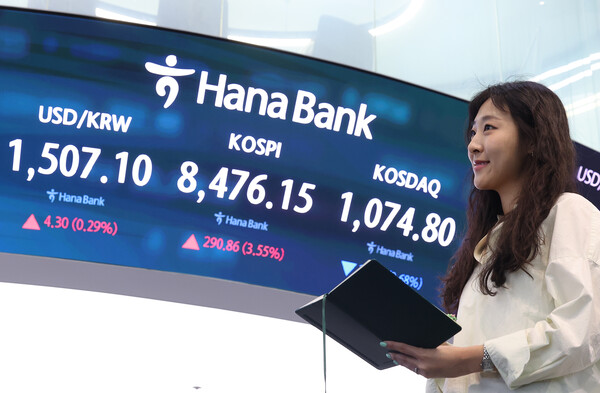
[Digital Today reporter Sangyeop Oh] South Korean stocks this week are expected to test whether concentration in semiconductor and artificial intelligence (AI) leaders begins to ease as the KOSPI nears 8,500. The KOSPI is extending its run to record highs, but internal market divergence is widening as gains are concentrated in some large caps.
On May 29, the KOSPI closed up 3.55 percent from the previous session at 8,476.15, approaching the 8,500 level. The Kosdaq fell 2.68 percent. Despite the KOSPI surge, only 210 stocks rose while 688 fell. That means the index rise relied on some leaders rather than broad strength.
Top names by trading value were concentrated in semiconductors and leveraged products, including SK Hynix, Samsung Electronics, Samsung Electro-Mechanics, KODEX Leverage and the KODEX SK Hynix single-stock leveraged ETF. Institutional and financial investment flows also clustered in leaders, lifting semiconductors and the information technology (IT) hardware sector.
Samsung Electronics jumped 5.8 percent, Samsung Electro-Mechanics rose 15.0 percent and LG Innotek surged 28.6 percent. Physical AI and software-related shares were also strong, not just semiconductors.
Buying spread to LG Electronics, LG CNS, Hyundai AutoEver, Hyundai Mobis, Samsung SDS and Naver as expectations grew over a possible visit to South Korea by Nvidia CEO Jensen Huang (젠슨 황) and anticipated meetings with the heads of major domestic groups.
The Kosdaq, however, was relatively weak. As flows concentrated in KOSPI large-cap leaders, semiconductor materials, parts and equipment, pharmaceutical and biotech, and SpaceX-related stocks faced profit-taking pressure. If the leader-heavy concentration continues, the return gap between the KOSPI and Kosdaq could widen further.
June trading is expected to have the character of catching breath after a sprint. Through May, South Korean stocks rose on upgrades to semiconductor profit outlooks despite Middle East risks, high oil prices, a weaker won and foreign selling.
It was a period in which domestic funds moved into sectors with high earnings visibility, absorbing foreign selling, rather than a market lifted by liquidity alone.
The industry sees the key for June as moderating the pace of gains rather than whether semiconductors are sold. Semiconductors remain the core leading sector, but the pace of gains in May was rapid and a gap in profit-outlook upgrades could emerge ahead of the pre-earnings season for second-quarter results.
A fall in oil prices on expectations of a U.S.-Iran ceasefire lowers discount rates and corporate cost burdens, but analysts say a process of easing overheating is needed after the index climbed in a short period.
As a result, next week's strategy appears to be maintaining semiconductors as a core pillar but responding on pullbacks rather than chasing. Outside semiconductors, sectors with different price trends from semiconductors and lower valuation 부담 could serve as complements.
Samsung Electronics and SK Hynix dependence in the KOSPI rise is also a factor that needs continued monitoring. Their combined share of KOSPI market capitalization has risen to 50 percent, and their share of profits based on 12-month forecast net income stands at 71 percent.
Some point to it as a sign of overheating if SK Hynix's market capitalization surpasses Samsung Electronics. SK Hynix's market cap has now risen to about 90 percent of Samsung Electronics' level.
The National Pension Service's decision to increase its domestic equity allocation is positive for medium- to long-term supply and demand. The NPS fund management committee decided to raise the domestic equity holding ratio to 20.8 percent from 14.9 percent. Expectations have formed that this could partly ease concerns about long-term outflows from South Korean stocks.
Ultimately, the key for next week's market is whether concentration in leaders can ease rather than whether the KOSPI breaks above 8,500. If profit momentum in semiconductor and AI-related stocks holds, the upside for the index could remain open. If the pattern of more decliners than advancers continues, investors may feel the market is weaker than the index suggests.
Roh Dong-gil (노동길), a researcher at Shinhan Investment Corp, said, "The key for the June market is moderating the pace rather than whether semiconductors are sold," adding, "Maintain interest in semiconductors, but holding and buying on dips is more suitable than chasing."
 Sangyeop Oh
yub@d-today.co.kr
Sangyeop Oh
yub@d-today.co.kr