
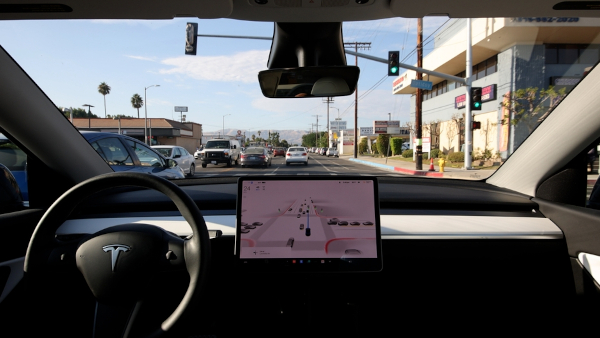
An investigation found that safety statistics Tesla has promoted for its Full Self-Driving (FSD) system were based on an inaccurate comparison method. Many internal staff who handled FSD training and data review were also reported to not trust the system.
On May 28, electric vehicle outlet Electrek reported that Reuters published findings from interviews with 9 former Tesla data labelers, 1 autonomous driving engineer and 11 traffic safety researchers.
At the centre of the controversy is the basis for Tesla’s promotion of FSD as being "up to 10 times safer than human drivers". Elon Musk and other executives have cited the figure multiple times since last year, and a chart shown at a shareholder meeting in November said accidents fell 85 percent.
The investigation found Tesla compiled data on its vehicles’ "airbag deployment crashes" and compared it with nationwide U.S. statistics for crashes that required towing. Because many towing crashes do not involve airbag deployment, critics said the comparison was not based on the same standard.
Marco Benedetti, a University of Michigan researcher, re-analysed the data using the same airbag deployment crash standard and found Tesla’s "10 times safer" figure fell to about 3 times. The analysis also said the comparison was difficult because Tesla vehicles had an average age of 4.1 years, versus 12.8 years for vehicles across the United States. Phil Koopman, a Carnegie Mellon University professor, criticised the comparison, saying it was like claiming his jet is faster than someone else’s World War Two bomber.
Traffic safety researchers were also sceptical. Of the 11 researchers interviewed, 10 said Tesla’s statistical approach was closer to misleading marketing than a scientific safety analysis.
Internal views were similar. Seven of the 9 former data labelers said they would not entrust their driving to FSD. A former autonomous driving engineer called Tesla’s safety claims "nonsense" and said, "Do not trust Elon Musk on this issue."
Data labelers who worked mainly out of the Utah office said FSD repeatedly showed problems even in basic road situations. They said they often saw cases where it failed to move aside properly for approaching emergency vehicles, did not keep enough distance from motorcycles, and did not respond appropriately at highway exits and in construction zones.
Concerns were also raised about pedestrian recognition. Reuters reported Tesla had a separate organisation focused on reviewing near-misses with pedestrians, and some employees said they repeatedly reviewed videos in which FSD failed to properly recognise pedestrians in crosswalks or children.
It was also reported that after the introduction of the so-called 'Mad Max' mode, which increased aggressive driving tendencies, cases were reported of exceeding speed limits by 20 to 30 miles per hour. One data labeler claimed to have seen video of a vehicle travelling at 60 miles per hour in a 25 miles per hour zone.
Critics also said the robotaxi development approach differed from Musk’s earlier explanations. Musk has stressed an autonomous driving approach that does not require reliance on high-definition maps, unlike rivals, but the investigation found Tesla conducted weeks of repeated test runs and map data collection at a Warner Bros site before unveiling its Cybercab last year.
Before the planned Austin robotaxi launch in June 2025, Tesla also carried out mapping work by filming traffic lights, road signs and the surrounding environment in a limited operating area, and its data labeling workforce was reportedly expanded to about 300. About 20 unsupervised robotaxis are currently operating in Austin, and some vehicles are still reported to have a safety monitor on board.
Regulatory risks also appear to be growing. The U.S. National Highway Traffic Safety Administration (NHTSA) is conducting 4 investigations related to FSD and Autopilot. The probes include cases involving running red lights, driving the wrong way and the adequacy of a 2023 Autopilot recall. Separately, a Florida court issued a damages verdict of $243 million against Tesla over a fatal crash linked to Autopilot.
Tesla told shareholders in November it would soon allow drivers to send text messages while using FSD, but it has not introduced the feature even after 6 months. Tesla’s FSD guidance page still states that activated features require active driver supervision and do not make the vehicle autonomous. The gap between Tesla’s promoted self-driving safety, its actual operating approach and internal assessments is again drawing attention.
 Jinju Hong
hongjj@d-today.co.kr
Jinju Hong
hongjj@d-today.co.kr